On this page
How the number is produced
Distance is the scroll speed integrated over time: every frame, add the current speed multiplied by the frame duration, then convert to whatever unit the game displays.
It is deliberately not derived from any position, because positions in these games stay small — the world scrolls past a fixed flyer — and because accumulating from speed stays accurate over arbitrarily long runs.
The consequence, which players notice quickly, is that distance accrues faster later in a run. At a starting speed of 150 units per second and a ceiling of 260, the last minute of a long run is worth about 70% more than the first.
What removing points does to players
Endless Wings has no score at all — only metres — and the effect on how people fly is consistent and slightly surprising.
Without a centre bonus to chase, players stop taking marginal lines and start taking whichever line is safest. Runs get longer almost immediately, often beyond the player's best in a scoring game with the same obstacles.
That is a fairly direct demonstration that score-chasing and survival are different objectives, and that most players have been optimising for the first while believing they were optimising for the second.
When distance is the right metric
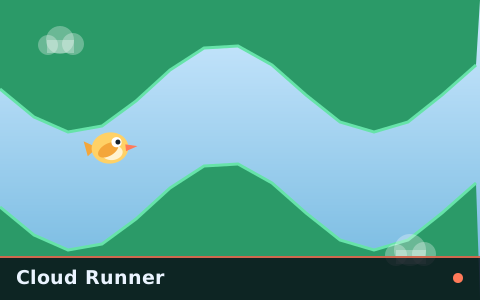
- Continuous fields. A corridor has no discrete events to count, so distance is the only honest measurement. Cloud Runner and Sky Tunnel both use it for this reason.
- Games about calm. Distance gives no moment-to-moment feedback, which is exactly what you want when the intent is a quiet run rather than a tense one.
- Games where events would distort the line. If counting gates would push players toward risky gates, counting metres removes the incentive.
It is the wrong metric whenever the game is about how you flew rather than how far. Distance cannot see accuracy, cannot see efficiency, and treats a scraped survival identically to a clean one.
Reading a distance score
Because later metres are cheaper to accumulate, distance scores compress the difference between a moderately good run and a very good one less than points-based scores do. A run that lasts twice as long is worth substantially more than twice as much.
That makes distance unusually motivating for incremental improvement: adding ten seconds to a long run moves the number a lot. It also means comparing a distance best across different games is meaningless, since every game has a different speed curve.
Why metres rather than an abstract number
A distance score could be displayed as any unit at all. Using metres is a deliberate choice and it does a small amount of real work.
An abstract score has no intuition attached to it: 4,800 points means nothing until you have seen a few other runs. A distance in metres carries a rough physical sense — most people have an instinct for how far 800 metres is — so a first run produces a number that already means something.
The conversion is arbitrary, and we say so plainly: logical units are divided by a constant to produce a figure that feels proportionate. It is not a claim about the size of the flyer or the scale of the world, neither of which are modelled on anything.
Key takeaways
- Distance is accumulated by integrating scroll speed over time, not derived from a position.
- Later metres arrive faster because speed rises, so a long run is worth more than proportionally more.
- Removing points makes players take safer lines, and runs usually get longer immediately.
- Distance is right for continuous fields and calm games, and wrong whenever the game is about how you flew.
Frequently asked questions
Why do my metres climb faster later in a run?
Can I compare distance scores between games?
Why does Endless Wings have no points?

Alex Morgan
Browser Games Editor & Interactive Gaming Content Specialist
Alex Morgan is the editorial byline for everything published on Flappy Arcade — the design notes, the flight-model tuning and the strategy guides for all 30 games. More about our editorial byline.
Published · Last updated
Games mentioned in this guide

Endless Wings
No score, no combo, no bonuses. Just distance — a quieter endless run measured in metres rather than points.
Cloud Runner
A continuous cloud corridor with no discrete gates. The walls never stop moving and neither can you.

Sky Tunnel
Cloud Runner's corridor, tighter and faster, in a tunnel that keeps closing in. Relentless, but never hidden and never unflyable.