Obstacle
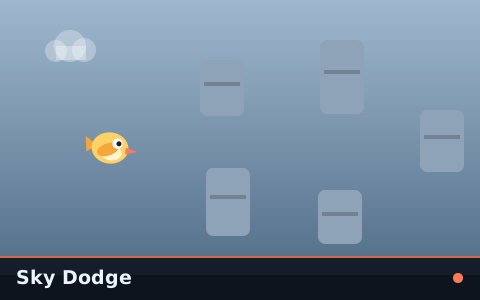
Sky Dodge
No gates at all. Free-floating barriers drift up and down, and you have to aim at where they will be.
Cloud Runner has no gates. The obstacle is a single continuous corridor that winds up and down the screen for as long as you can stay inside it. Where a gate game gives you discrete decisions, this gives you one long one that never finishes.
Stay inside the corridor for as long as you can. Distance flown is the recorded result; there are no gates to count.
| Action | Keyboard / mouse | Touch |
|---|---|---|
| Flap | Space, W or Arrow Up | Tap anywhere on the play area |
| Pause / resume | P or Esc | Pause button in the game bar |
| Restart | R | Restart button in the game bar |
Pause with P or Esc, restart with R. The game pauses automatically if you switch tabs. More detail in keyboard controls for browser games and touch controls for arcade games.
The corridor is generated from two sine terms of different periods, which produces a wandering centre line that never repeats obviously and never jumps. Its width narrows gradually as the run goes on and its wander amplitude increases, so the corridor gets both tighter and more aggressive — but always smoothly, because a discontinuity in a continuous wall would be a wall.
What this tests is the thing every other game on the site tests in short bursts: holding a height and changing it deliberately. There is no moment here where you are safe and no moment where you have nothing to do. A gate game lets you coast between obstacles; a corridor does not, and that makes it unusually good practice.
The characteristic failure mode is over-correction. Because the walls are always close, every small error feels urgent, and the instinct is to flap hard. A hard flap in a narrow corridor puts you into the ceiling roughly as often as it saves you from the floor. The players who do well here are the ones who make many small corrections instead of a few large ones.
Distance is the recorded metric rather than score, because there is nothing discrete to count. The corridor's minimum width is capped well above the flyer's diameter plus a correction, so it never becomes a squeeze that only luck can pass.
Cloud Runner uses the site's shared flight model: gravity acts continuously on your vertical velocity, a flap sets that velocity rather than adding to it, and hard caps on rise and fall speed mean no situation is ever unrecoverable. The mechanics this game leans on are Flapping, Gravity, Narrow Gaps and altitude control.
If you want the numbers behind that, how flappy-style games work sets out the whole model, and how flapping mechanics work explains why a flap that sets velocity behaves so differently from one that adds to it.
Chosen by shared category, mechanics and difficulty — not at random.
No gates at all. Free-floating barriers drift up and down, and you have to aim at where they will be.

Cloud Runner's corridor, tighter and faster, in a tunnel that keeps closing in. Relentless, but never hidden and never unflyable.
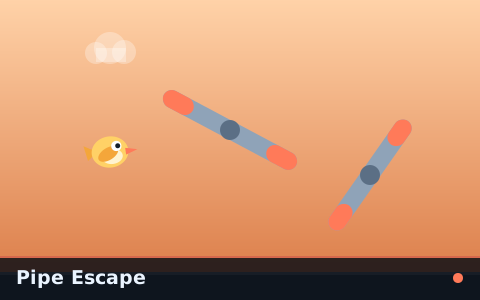
Rotating bars instead of pillars. The opening is always there — it just is not always where you are.

Three stages of escalating gate patterns, then a shutter that closes on a rhythm you have to time, not react to.
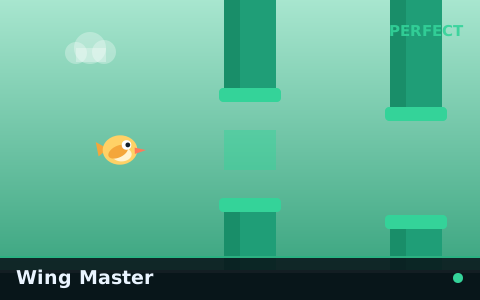
Scores how well you flew, not just whether you survived. The centre band of every gate is worth chasing.
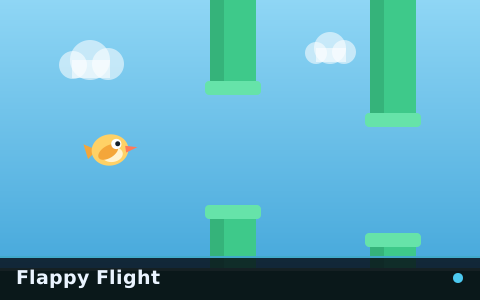
The reference flappy game: one flyer, one gap type, a speed that keeps climbing and nothing else in the way.
Technique
Why a narrow gap entered level is easier than a wide one entered diagonally, how to stop over-correcting, and when a gap that feels impossible genuinely is not.
Cornerstone Guide
Why precision is a separate skill from speed, how narrow a gap can fairly be, what perfect-pass scoring is for, and the three-step method for controlling altitude.
Scoring
How distance is calculated, why it rewards late metres more than early ones, what removing points does to how people fly, and when distance is the right metric.
Browse the flappy obstacle games, the full library of 30 games, or the newest additions. If you are not sure what to try next, the best flappy games to play online suggests an order.