On this page
Set, do not add
There are two ways to write a flap and the choice defines the entire game.
| Model | Code | Consequence |
|---|---|---|
| Additive | vy -= 430 | Rapid tapping accumulates into a launch |
| Assignment | vy = -430 | Two quick taps are barely different from one |
We use assignment, as almost every good game in the genre does. The reason is that the additive model rewards input speed, and input speed is not an interesting skill — it turns the game into a mashing contest in which the optimal strategy is to press as fast as physically possible and the ceiling becomes the only real obstacle.
With assignment, the flap is a reset rather than a push. Whatever you were doing, you are now travelling upward at exactly 430 units per second. That makes the outcome of a flap depend entirely on when you made it relative to your state, which is the interesting variable, and it is why the same input produces a dramatic rescue from a fast fall and almost nothing while already climbing.
The cooldown nobody notices
There is a 55-millisecond minimum between flaps in every game on this site. It is short enough that no player has ever mentioned it and long enough to do a specific job.
Without it, a held key with keyboard auto-repeat, or a stray double-tap from a touchscreen registering two contacts, produces several flaps within a few frames. With assignment semantics those extra flaps do almost nothing to velocity, but they do restart the wing animation and retrigger the sound, which reads as a glitch even though the physics are fine.
The cooldown also makes the input model honest across devices. A mouse click, a space bar press and a screen tap all produce exactly one flap, with exactly the same effect, no matter how the hardware reports them.
Rotation lag is what reads as weight
The flyer's body angle is purely cosmetic — it has no effect on collision, which is a circle — and yet it is one of the most important values in the game.
The body angle chases the current vertical velocity: nose up while climbing, nose down while falling. The critical detail is that it chases with a deliberate lag rather than snapping to it. When you flap, the flyer rises immediately but rotates over about a fifth of a second, which produces the impression of a body with mass being thrown upward.
Remove that lag and the same game feels weightless and cheap — the flyer becomes a cursor rather than a creature. It is the clearest example on the site of animation doing real design work rather than decorative work.
The rotation does nothing mechanically and changes everything perceptually. Snap it to the velocity and the game feels like a spreadsheet.
The wing animation does a related job. Its phase speeds up while rising and slows while falling, which gives a second, redundant channel of information about your current vertical state — useful when your eyes are on the gap rather than on the flyer.
Flap force, and what different values feel like
Flap force is chosen relative to terminal velocity rather than in isolation. The useful question is: what fraction of a full-speed fall does one flap undo?
| Game | Flap force | Terminal fall | Ratio |
|---|---|---|---|
| Flappy Flight | −430 | 620 | 0.69 |
| Bird Blitz | −500 | 760 | 0.66 |
| One-Tap Flyer | −300 | 360 | 0.83 |
| Underwater Flap | −280 | 300 | 0.93 |
A high ratio means one flap almost fully reverses a worst-case fall, which is forgiving. A low ratio means a bad fall needs two or three inputs to fix, which is demanding. Notice that One-Tap Flyer is forgiving not because its flap is strong — it is the weakest on the site — but because its falls are slow.
That is the general principle: flap force means nothing on its own. It is only meaningful as a proportion of what gravity can do to you.
Variations on the flap
The held thruster
Rocket Flap replaces the impulse with a continuous acceleration that runs while the button is held. Altitude stops being a series of jumps and becomes a steered quantity, which is a genuinely different skill — and one that people good at ordinary flapping are often bad at, because their instinct is to tap.
A held thruster needs a limiter or it trivialises the game, so it has a fuel gauge: about 2.6 seconds of continuous burn, refilling at a third of that rate while gliding. That makes every climb something you pay for with a glide.
The inverted vent
Balloon Escape keeps the impulse and reverses its sign. Buoyancy lifts you constantly and the button pushes you down. Mechanically it is the same one-line change; experientially it is the hardest control on the site, because the press-means-up association is learned far more deeply than players realise.
The momentum flap
Ice Flyer keeps everything and removes the drag. The flap is identical; what changes is how long its effect persists. The result is delayed overshoot — you correct, arrive perfectly, and keep rising because the input had not finished.
Why flapping less is usually the answer
Nearly every problem a new player has in a flappy game is solved by flapping less, and the mechanics above explain why.
- A flap while rising is nearly wasted. Going from −300 to −430 is a change of 130; going from +620 to −430 is a change of 1,050. Same input, eight times the effect.
- Every flap buys a fall. Because gravity is constant, the higher a flap takes you, the longer you spend coming back down — which is time during which you are accelerating rather than choosing.
- Extra flaps compound. Two flaps put you high, which means a long fall, which feels alarming, which produces another flap. The pattern is self-sustaining and it ends at the ceiling.
The concrete habit is to change altitude by adding exactly one flap to your rhythm or skipping exactly one, and never by bursting. It is a small rule and it is worth more than any amount of reaction speed.
Key takeaways
- A flap sets velocity rather than adding to it, which stops input speed from being a strategy.
- A 55 ms flap cooldown makes keyboard repeat and stray double-taps behave identically across devices.
- Rotation lag is purely cosmetic and is what makes the flyer read as having mass.
- Flap force is only meaningful as a ratio to terminal fall speed, not as a number on its own.
- Flapping while already rising changes your velocity roughly eight times less than flapping from a fast fall.
Frequently asked questions
Does tapping faster make me climb faster?
Why does my flyer tilt when it flaps?
Is a stronger flap always better?
Why do some games use a held button instead?

Alex Morgan
Browser Games Editor & Interactive Gaming Content Specialist
Alex Morgan is the editorial byline for everything published on Flappy Arcade — the design notes, the flight-model tuning and the strategy guides for all 30 games. More about our editorial byline.
Published · Last updated
Games mentioned in this guide
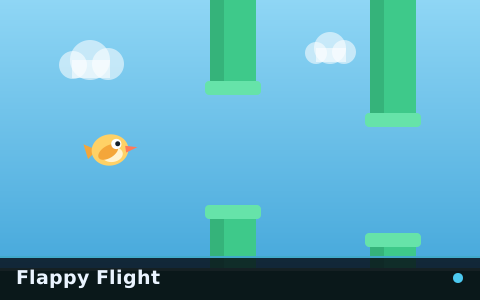
Flappy Flight
The reference flappy game: one flyer, one gap type, a speed that keeps climbing and nothing else in the way.
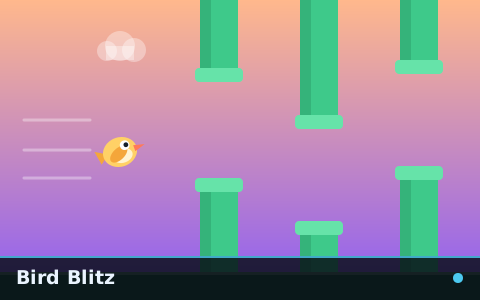
Bird Blitz
Starts where Flappy Flight finishes. A fast endless run with a speed ramp that never lets the rhythm settle.

Rocket Flap
A thruster you hold instead of a flap you tap. Altitude becomes continuous, and fuel makes it finite.

Balloon Escape
The balloon rises on its own. Your button vents it downward — every instinct you have is now wrong.