On this page
Diagnose before you practise
Most advice for this genre is a list of tips, which is close to useless because you cannot work on eight things at once. What actually improves a score is finding the one error that is currently costing you the most and removing it.
There is a three-run diagnostic that identifies it reliably. Play three runs of Flappy Flight and record only one thing about each death: did you hit the top half of a gate, the bottom half, the ceiling, or the floor?
| Where you die | Cause | Fix |
|---|---|---|
| Bottom half of gates | Flapping too late | Commit at a fixed reference point on screen |
| Top half of gates | Double flapping | Build a deliberate pause after every flap |
| The ceiling | Panic flapping after a scare | Skip one flap after every near miss |
| The floor | Waiting for certainty | Flap on the decision, not on the confirmation |
Almost nobody spreads evenly across all four. One will dominate, and that is your project for the next few sessions. Fixing it usually adds more to a score than every other adjustment combined.
The four habits, in the order worth building them
1. Watch the gap, not the flyer
This is the highest-value habit in the genre and the cheapest to adopt. Your eyes should rest roughly two-thirds of the way to the next opening; peripheral vision handles the flyer perfectly well. A flap takes about a third of a second to express itself, so corrections based on the flyer's current position are always aimed at a situation that has already moved on.
A quick test: after a run, try to describe your flyer's wing colour. If you can, you were looking in the wrong place.
2. Arrive level
A gap entered while climbing or falling is functionally much narrower than a gap entered flat, because your vertical velocity carries you across it while you are inside it. Set your height before the gate rather than at it.
Wing Master is built to train this: its centre-band scoring is effectively impossible to hit consistently without level arrivals, so the score becomes a direct readout of whether you are doing it.
3. Change altitude in single steps
Find the flap frequency that holds a constant height, then climb by adding exactly one flap and descend by skipping exactly one. Bursts are the enemy: they are easy to start and hard to stop, and every burst buys you an overshoot to correct.
4. Protect the combo
In any game with a multiplier, consistency is worth more than aggression. Twenty clean gates at a rising multiplier beat thirty gates with two crashes in the middle, because the crashes reset you to ×1 and you spend most of the run there.
This has a direct consequence for collectibles: an eight-point orb is almost never worth risking a ×3 multiplier that was about to apply to the next dozen gates.
Practise deliberately, not repeatedly
Playing a lot is not the same as practising. The difference is whether each run has a stated purpose you can evaluate afterwards.
- Pick one thing. "This run I will not flap twice in a row." Not "this run I will do better."
- Accept a worse score. A run spent enforcing a new habit will usually score below your average. That is the cost of changing something.
- Evaluate immediately. Did you do the thing? Not: did you score well?
- Five runs, then stop. Deliberate practice is tiring in a way that ordinary play is not.
Flappy Sprint is the best vehicle for this because its runs are exactly sixty seconds. Twenty attempts take twenty-five minutes, the sample size is large enough to see a change, and no single run is precious enough to be afraid of wasting.
Warm up, and know when to stop
Reaction time is genuinely worse in the first thirty seconds of a session than it is two minutes in. If your first run of an evening is consistently poor and your third or fourth is your best, that is not superstition — and it means your first attempt should be treated as a warm-up rather than an attempt.
The other half is knowing when the session is over. Performance degrades measurably with fatigue, and the run where you are certain you are about to beat your best is very often the run where you are already several tenths slower than you were an hour ago.
A simple stopping rule that works: if three runs in a row end earlier than your recent average, the session is finished. Continuing past that point produces worse scores and, more importantly, reinforces sloppier habits.
Score-specific tactics
Everything above is about surviving longer, which is the main driver of score. There are a few things that raise score without raising survival.
- Take centre lines. In any game with a perfect-pass bonus, the centre of a gap is worth several times the edge and costs nothing extra once you can arrive level.
- Chain rather than collect. In collectible games the multiplier usually matters more than the item. A clean chain of small pickups beats a broken chain of large ones.
- Spend power-ups where they do the most. Slow motion is worth four times as much in a dense cluster as on open field. A shield saved for a hard stage is worth more than one spent on an early mistake.
- Know what the game records. Sky Coin Run records coins, Wing Master records perfect passes, Gap Hunter records gates. Optimising for score in a game that records something else is a common and expensive mistake.
A realistic improvement curve
Scores in this genre do not rise smoothly. They plateau and then jump, and knowing that in advance makes the plateaus much less discouraging.
The reason is that improvement comes from habits becoming automatic rather than from incremental sharpening. While you are consciously enforcing "arrive level", it costs you attention and your scores stay flat or dip. When it stops costing attention, the attention it was using becomes available for reading further ahead, and the score jumps.
Expect the first jump within a session or two of fixing your dominant error, and expect the next one to take considerably longer. Plateaus of a week are normal and are usually the sign that something is in the process of becoming automatic.
Key takeaways
- Diagnose first: three runs and a note of where you died identifies your dominant error.
- Build habits in order — watch the gap, arrive level, change altitude in single steps, protect the combo.
- Deliberate practice means one stated goal per run and accepting a worse score while you change something.
- Treat your first run of a session as a warm-up, and stop after three consecutive below-average runs.
- Scores plateau and then jump, because improvement comes from habits becoming automatic rather than sharper.
Frequently asked questions
Why does my score get worse when I try harder?
How long should a practice session be?
Is it better to play one game a lot or many games a little?
Do collectibles help or hurt my score?

Alex Morgan
Browser Games Editor & Interactive Gaming Content Specialist
Alex Morgan is the editorial byline for everything published on Flappy Arcade — the design notes, the flight-model tuning and the strategy guides for all 30 games. More about our editorial byline.
Published · Last updated
Games mentioned in this guide
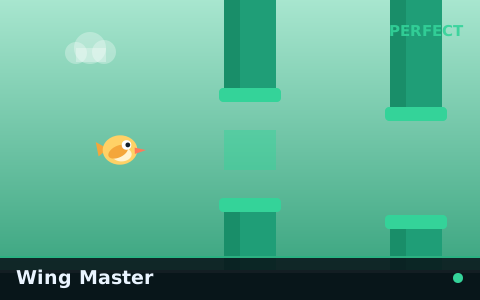
Wing Master
Scores how well you flew, not just whether you survived. The centre band of every gate is worth chasing.
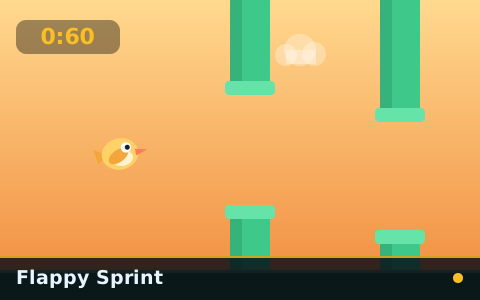
Flappy Sprint
Sixty seconds, no more. Every attempt costs exactly one minute, which makes trying again almost free.
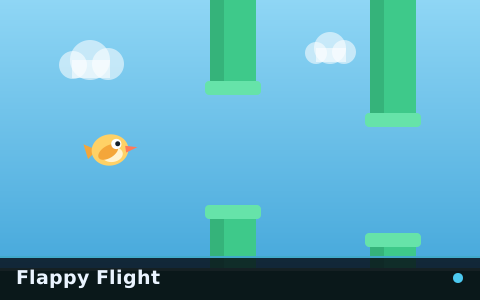
Flappy Flight
The reference flappy game: one flyer, one gap type, a speed that keeps climbing and nothing else in the way.
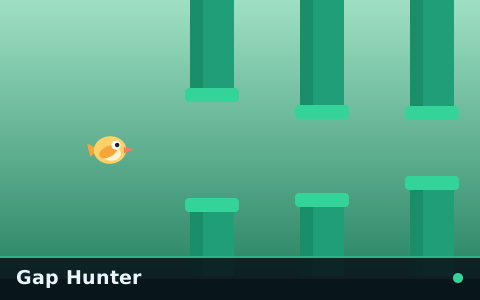
Gap Hunter
The openings shrink with every gate you pass. They stop shrinking at a width that is genuinely passable — eventually.