Endless
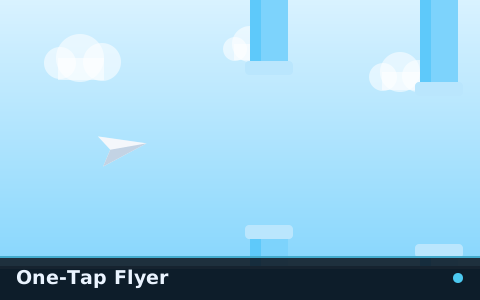
One-Tap Flyer
The gentlest game on the site. A floaty paper plane, wide spacing and enough time to see every decision coming.
Flappy Flight is the game we point every new visitor at first. It is the genre stripped to its essentials: a bird that falls constantly, a flap that pushes it up, and a field of capped pillars with an opening to thread. Every other game on this site is a variation on the habits this one teaches.
Pass through as many gates as you can without touching a pillar or the ground. Every gate scores; centred passes score more and build your combo multiplier faster. You cannot climb above the top of the screen — the flyer is held there, and the next pillar will catch you.
| Action | Keyboard / mouse | Touch |
|---|---|---|
| Flap | Space, W or Arrow Up | Tap anywhere on the play area |
| Pause / resume | P or Esc | Pause button in the game bar |
| Restart | R | Restart button in the game bar |
| Mute | — | Speaker button in the game bar |
Pause with P or Esc, restart with R. The game pauses automatically if you switch tabs. More detail in keyboard controls for browser games and touch controls for arcade games.
The flight model is the site's reference tuning, and the numbers are worth knowing because every other game is described relative to them. Gravity pulls at 1,500 units per second squared. A flap sets your vertical velocity to −430 immediately rather than adding to it, which is what makes a flap feel like a decision rather than an accumulation. Terminal fall speed is capped at 620, so a long drop is always recoverable if you start the recovery in time.
Gap height starts at 205 units and shrinks toward 150 as the run goes on, while the scroll speed climbs from 172 toward a ceiling of 300. Both curves are exponential approaches rather than straight lines: about half of the total change has happened by twenty seconds, and the last fraction never quite arrives. Past roughly ninety seconds the game has stopped getting harder and is simply holding its hardest state.
Gap placement is where most of the fairness work lives. The vertical centre of each new opening is chosen relative to the previous one and can never move more than a fixed distance, which is derived from how far the flyer can climb in the time the current scroll speed allows. It also never sits within 26 units of the ceiling or the floor. Between them, those two rules mean the field cannot produce a sequence that is physically impossible to fly — if a run ends here, the line existed.
Scoring is one point per gate with a combo multiplier that climbs with consecutive clean passes and resets when you crash. Threading the central third of an opening awards a perfect-pass bonus and a distinct sound. That bonus is the reason a careful player usually outscores a fast one over the same number of gates.
Flappy Flight uses the site's shared flight model: gravity acts continuously on your vertical velocity, a flap sets that velocity rather than adding to it, and hard caps on rise and fall speed mean no situation is ever unrecoverable. The mechanics this game leans on are Flapping, Gravity, Obstacle Avoidance and timing.
If you want the numbers behind that, how flappy-style games work sets out the whole model, and how flapping mechanics work explains why a flap that sets velocity behaves so differently from one that adds to it.
Chosen by shared category, mechanics and difficulty — not at random.
The gentlest game on the site. A floaty paper plane, wide spacing and enough time to see every decision coming.
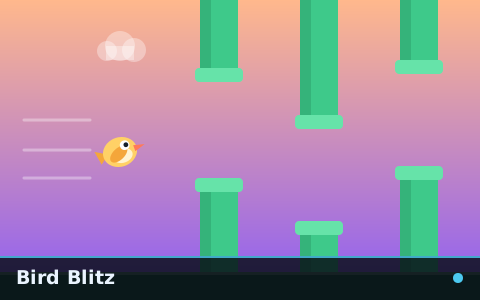
Starts where Flappy Flight finishes. A fast endless run with a speed ramp that never lets the rhythm settle.

No score, no combo, no bonuses. Just distance — a quieter endless run measured in metres rather than points.
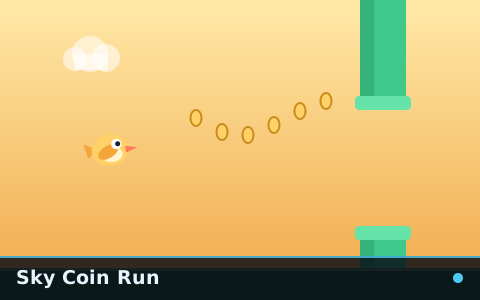
Every gate has two routes: the safe one and the one with the coins on it. They are rarely the same route.
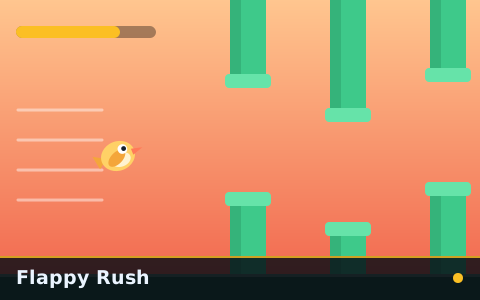
Starts readable and ends somewhere your rhythm cannot follow. A pure speed ramp with a visible speed meter.
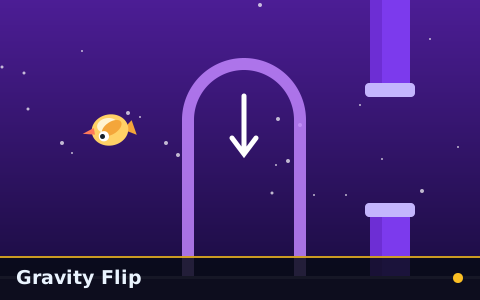
Fly through a flip gate and down becomes up. Your controls do not change — everything else does.
Cornerstone Guide
What actually defines a flappy-style arcade game, where the format came from, why one input is enough, and how the six kinds of flappy game differ.
Cornerstone Guide
The machinery underneath a flappy game: the flight model, the game loop, obstacle generation, collision, scoring and the difficulty curve — with the numbers we use.
Cornerstone Guide
A structured way to get better rather than a list of tips: what actually limits your score, how to diagnose it in three runs, and what to practise in what order.
Browse the flappy endless games, the full library of 30 games, or the newest additions. If you are not sure what to try next, the best flappy games to play online suggests an order.