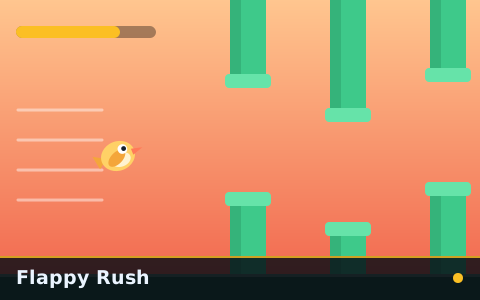
Reflex
Flappy Rush
Starts readable and ends somewhere your rhythm cannot follow. A pure speed ramp with a visible speed meter.
Flappy Sprint gives you sixty seconds. Not sixty seconds to survive — sixty seconds to score, after which the run ends regardless of how well you are doing. It is the most repeatable game on the site, because every attempt costs the same fixed, small amount of time.
Score as many points as possible in sixty seconds. Gates are worth more as the clock runs down, and a crash costs three seconds rather than ending the run.
| Action | Keyboard / mouse | Touch |
|---|---|---|
| Flap | Space, W or Arrow Up | Tap anywhere on the play area |
| Pause / resume | P or Esc | Pause button in the game bar |
| Restart | R | Restart button in the game bar |
Pause with P or Esc, restart with R. The game pauses automatically if you switch tabs. More detail in keyboard controls for browser games and touch controls for arcade games.
A fixed timer changes the psychology of an arcade game more than almost any other mechanic. In an endless game, a bad run feels like a waste and a good run makes you reluctant to stop. Here, every attempt is a minute, win or lose, and the decision to try again costs nothing you have to think about. People play far more runs of this than of anything else here.
It also changes the correct strategy in a way that catches people out. Because the clock is the only resource, dying early is catastrophic and dying at 58 seconds is nearly free. That means caution pays enormously in the first thirty seconds and barely at all in the last ten — the optimal run is conservative early and reckless late, which is the opposite of how most players instinctively pace themselves.
Crashing does not end the attempt: it costs you three seconds of the clock and restarts you in clear air. That rule is what makes the late-run recklessness viable, and it is also why the scoring can be aggressive — gates are worth more as the clock runs down, rising from 10 points in the first twenty seconds to 25 in the last ten.
The field itself is the standard gate generator at moderate speed with a slight ramp. Nothing about the obstacles is unusual. All of the design is in the clock.
Flappy Sprint uses the site's shared flight model: gravity acts continuously on your vertical velocity, a flap sets that velocity rather than adding to it, and hard caps on rise and fall speed mean no situation is ever unrecoverable. The mechanics this game leans on are Flapping, Gravity, Timing and speed.
If you want the numbers behind that, how flappy-style games work sets out the whole model, and how flapping mechanics work explains why a flap that sets velocity behaves so differently from one that adds to it.
Chosen by shared category, mechanics and difficulty — not at random.
Starts readable and ends somewhere your rhythm cannot follow. A pure speed ramp with a visible speed meter.
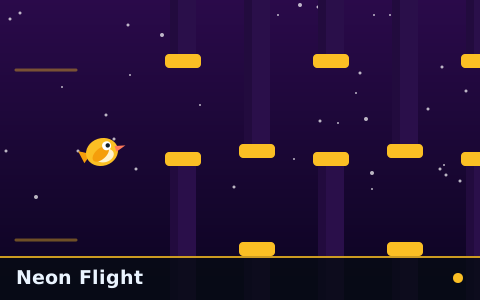
Fast from the first gate, with obstacles packed into sequences that leave almost no recovery room.

Gates that move once, mid-approach, after flashing a warning. A pure test of how fast you can change a plan.
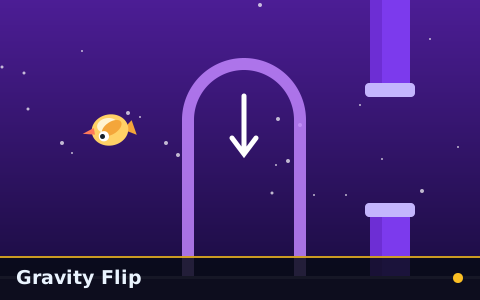
Fly through a flip gate and down becomes up. Your controls do not change — everything else does.
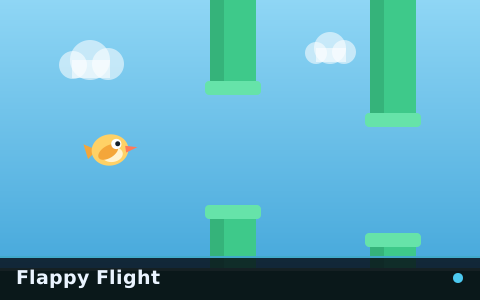
The reference flappy game: one flyer, one gap type, a speed that keeps climbing and nothing else in the way.
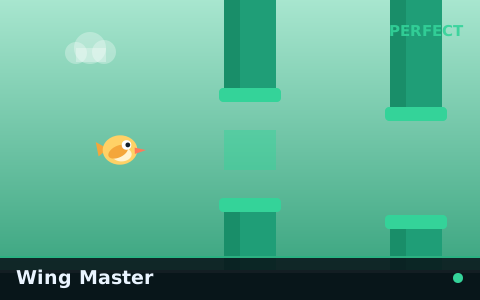
Scores how well you flew, not just whether you survived. The centre band of every gate is worth chasing.
Modes
Why a fixed clock changes the correct strategy, how crash penalties replace death, why gate values escalate, and what makes time attack the best practice mode.
Practice
The difference between playing a lot and practising, how to structure a session, and why the run that feels wasted is usually the one that taught you something.
Design
Why a ninety-second game holds attention that a ninety-minute one cannot, what the retry loop actually does, and how session length shapes everything else in a design.
Browse the flappy reflex games, the full library of 30 games, or the newest additions. If you are not sure what to try next, the best flappy games to play online suggests an order.