On this page
A fixed clock inverts the risk calculation
In a survival game, the resource is your life and the correct strategy is roughly constant throughout: fly carefully. In a time attack the resource is the clock, and the correct strategy changes continuously as it runs down.
Early in a sixty-second run, a crash is expensive because it costs you a large fraction of your remaining opportunity. Late in the run, a crash costs almost nothing because there was barely any opportunity left to lose.
The optimal run is therefore conservative early and reckless late — which is the opposite of how most players instinctively pace themselves. People tend to start aggressively while they feel fresh and tighten up as the clock runs down, and that is exactly backwards.
Crash penalties instead of death
The mechanic that makes a time attack work is that crashing does not end the attempt. In Flappy Sprint it costs three seconds of the sixty and restarts you in clear air.
That single rule does several things at once. It makes late-run aggression viable, which is what makes the pacing interesting. It guarantees every attempt costs exactly one minute, which makes retrying free. And it removes the frustration of a run ending at four seconds, which in a survival game is simply a wasted attempt.
The penalty has to be large enough to matter and small enough to survive. Three seconds out of sixty is 5% — noticeable four times over, which is roughly the point at which a run stops being competitive.
Escalating values
Gates in Flappy Sprint are worth 10 points in the first twenty seconds, 15 in the middle twenty and 25 in the last twenty.
Without escalation, the end of a run is worth gambling with only for fun. With it, the gamble is mathematically correct — a crash at 55 seconds costs three seconds of 25-point gates and the aggressive line that caused it might have earned more.
It also fixes the anticlimactic ending that flat-value time attacks have, where the last ten seconds are identical to the first ten and you are simply waiting for the clock.
Why time attack is the best practice mode
Fixed-length runs give you something no other mode does: a large, directly comparable sample.
- Twenty attempts in twenty-five minutes. Enough to see a change rather than a fluctuation.
- Every run is the same length, so scores are directly comparable without adjusting for duration.
- No run is precious. You are never afraid to spend one testing something.
- Failure is cheap, which means you will actually try the thing you were avoiding.
Track your average across ten runs rather than your best. A best is one lucky sample; an average is the number that actually moves when you improve.
Choosing the clock length
Sixty seconds is not arbitrary. Run length in a time attack determines what the mode actually measures, and the options behave quite differently.
- 15–30 seconds: measures your opening. Too short for the pacing strategy to matter.
- 45–90 seconds: long enough for early caution and late aggression to be genuinely different strategies, short enough that attention stays constant.
- 3–5 minutes: attention becomes a factor again, which makes it a survival mode with a timer attached.
Sixty sits in the middle band and has a practical advantage: it is a round number people can plan around. "One more minute" is a much easier thing to agree to than "one more run of indeterminate length".
Key takeaways
- In a time attack the resource is the clock, so the correct strategy is conservative early and reckless late.
- A crash penalty instead of death makes late aggression viable and every attempt cost the same.
- Escalating gate values make the endgame worth gambling with rather than a wait for the clock.
- Fixed-length runs give a large comparable sample, which makes time attack the best practice mode.
Frequently asked questions
Why should I play cautiously at the start?
How big should a crash penalty be?
Why track my average rather than my best?

Alex Morgan
Browser Games Editor & Interactive Gaming Content Specialist
Alex Morgan is the editorial byline for everything published on Flappy Arcade — the design notes, the flight-model tuning and the strategy guides for all 30 games. More about our editorial byline.
Published · Last updated
Games mentioned in this guide
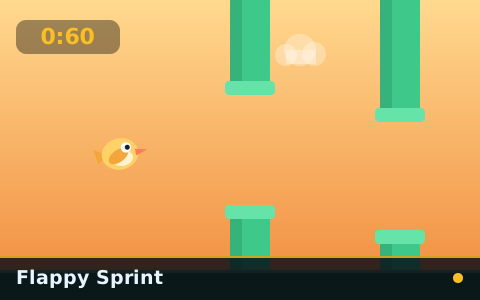
Flappy Sprint
Sixty seconds, no more. Every attempt costs exactly one minute, which makes trying again almost free.
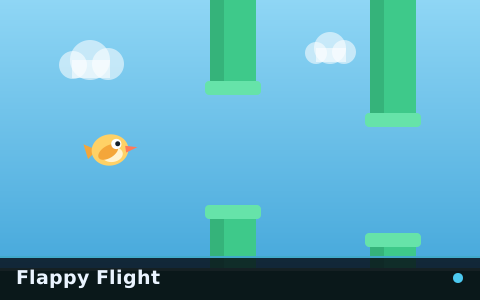
Flappy Flight
The reference flappy game: one flyer, one gap type, a speed that keeps climbing and nothing else in the way.

Ultimate Flappy Challenge
Four stages, each with its own objective, layered on top of each other. The hardest game here, and the most specific about why you failed.