On this page
The retry loop is the product
In a long game, failure is an interruption: you lose progress, reload, and re-cover ground you had already covered. In an arcade game, failure is the mechanic. The loop of attempt, fail, adjust and retry is not a consequence of the design — it is the thing being designed.
That is why restart speed is the single most important technical property of an arcade game. A restart that takes three seconds instead of one does not cost you two seconds; it costs you the willingness to make a fourth attempt, which is where learning actually happens.
Low commitment is the hook
A ninety-second run asks for almost nothing. You can start one without deciding to spend an evening, and that removes the main barrier to starting anything.
Flappy Sprint takes this to its logical end: every attempt costs exactly sixty seconds, win or lose. Because the cost is fixed and small, the decision to try again requires no deliberation at all — and people play far more runs of it than of anything else here.
The same property is what makes the format work on a phone. A game you can start while waiting for a kettle has to be one you can also abandon mid-run without losing anything.
Failure has to be attributable
Short sessions only stay engaging if you can tell what went wrong. A ninety-second run that ends for reasons you cannot identify is not a quick retry — it is a slot machine.
This is why arcade games tend toward small numbers of variables. One input, one flyer, one kind of obstacle. With one variable, a failure produces a clear question with a findable answer, and answering it is what pulls you into the next attempt.
It is also why a game should be hard for one reason at a time. A game that is hard for four reasons produces failures you cannot attribute, and unattributable failure is the fastest way to end a session.
What session length dictates
Once you fix the target run length, most of the rest of the design follows from it.
| If a run is… | Then… |
|---|---|
| 30–90 seconds | No save system, no unlocks, score as progression |
| Restart in ~1 second | No menus between attempts, no confirmation dialogs |
| Playable one-handed | One input, no settings required before starting |
| Abandonable mid-run | Nothing is lost by closing the tab |
Every one of those is a constraint most games would experience as a limitation. For an arcade game they are the format working as intended, and fighting them — adding a tutorial, a progression system, an account — reliably makes the game worse at the thing it is for.
The cost of a bad long game versus a bad short one
There is an asymmetry worth noticing. A bad thirty-second run costs you thirty seconds. A bad thirty-minute session costs you thirty minutes and, usually, some goodwill toward the game.
That asymmetry is why arcade games can afford to be much harder than longer games. A punishing difficulty curve is tolerable when failure is cheap, and it becomes intolerable the moment a failure costs real time. It is also why adding save points, unlocks or long-form progression to an arcade game tends to make it worse — each one raises the cost of failure, and the design was built assuming that cost was near zero.
The same logic explains why the restart button matters more than almost any other piece of UI in the genre.
Key takeaways
- In an arcade game, failure is the mechanic rather than an interruption — the retry loop is the product.
- Restart speed matters more than almost anything else, because slow restarts cost attempts rather than seconds.
- Short sessions only work when failure is attributable, which is why arcade games keep variables few.
- Fixing a target run length determines most of the rest of the design.
Frequently asked questions
Why do short games feel harder to put down?
Is a sixty-second game too short to be satisfying?
Should arcade games have progression systems?

Alex Morgan
Browser Games Editor & Interactive Gaming Content Specialist
Alex Morgan is the editorial byline for everything published on Flappy Arcade — the design notes, the flight-model tuning and the strategy guides for all 30 games. More about our editorial byline.
Published · Last updated
Games mentioned in this guide
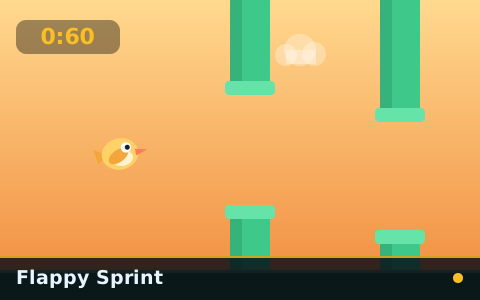
Flappy Sprint
Sixty seconds, no more. Every attempt costs exactly one minute, which makes trying again almost free.
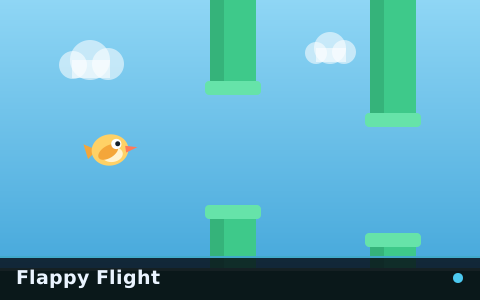
Flappy Flight
The reference flappy game: one flyer, one gap type, a speed that keeps climbing and nothing else in the way.

One-Tap Flyer
The gentlest game on the site. A floaty paper plane, wide spacing and enough time to see every decision coming.