On this page
Hard and unfair are different things
A hard obstacle is one you can pass with skill you do not yet have. An unfair one is one you cannot pass with any skill, or one that gives you no way to learn.
Players are extremely good at telling these apart, even when they cannot articulate why. The feeling of having been cheated arrives immediately and it ends sessions, because there is no point practising something that does not respond to practice.
A hard game says: you were not good enough yet. An unfair game says: it would not have mattered.
The five rules
- Reachability. Consecutive openings must be within a vertical distance the flyer can cover in the time available at the current speed.
- Edge margin. No opening sits so close to the ceiling or floor that it can only be entered from one direction.
- Minimum clearance. Every gap is at least the flyer's diameter plus one correction at terminal fall speed.
- Visible lead. Anything that moves shows at least one full cycle of its movement before the player must commit.
- Telegraphed change. Anything that will change announces it first, through at least two channels, with enough warning to act on.
Those five are applied to every obstacle on this site. Together they support a specific claim: if a run here ends on a pattern, that pattern had a flyable line through it.
What unfairness usually looks like
- Random gap placement. A ceiling gap immediately after a floor gap at speed. This is the most common and the easiest to fix.
- Off-screen spawns that are already dangerous. An obstacle that becomes lethal before it is fully visible.
- Hitboxes larger than the drawing. Consistent, invisible, and it poisons trust in everything else.
- Randomised timed hazards. A beam with a random period cannot be learned, which makes practice worthless.
- Difficulty spikes rather than curves. A sudden step change is indistinguishable from a bug.
- Simultaneous demands with no ordering. Two hazards requiring opposite responses at the same instant.
How a player can tell
If a game feels unfair, there are three questions that usually settle it.
- Did I see it coming? If the information was on screen and you did not use it, the game was hard.
- Was there a line? Replay the moment mentally. If some sequence of inputs would have worked, the game was hard.
- Would I know what to do differently? If yes, the game was hard. If the honest answer is "nothing", it was unfair.
Applied to our games, the answer should be "hard" every time. If it is not — if you hit a pattern here that genuinely had no line through it — that is a bug in the generator rather than a difficulty choice, and the contact page exists partly for that.
Unfairness people forgive, and unfairness they do not
Not all perceived unfairness is equal. Players are surprisingly tolerant of some kinds and completely unforgiving of others.
Tolerated: high difficulty, sudden increases in pace, dense sections, losing a long run to a single mistake. All of those are attributable, and attributable failure is survivable however annoying it is.
Not tolerated: hitboxes that do not match the drawing, hazards with no warning, and patterns with no line through them. The common feature is that the player's model of the game was wrong through no fault of their own, which means every future decision is now uncertain too.
That is the real cost of an unfair mechanic. It does not just lose you one run; it makes the player stop trusting their own reads, and after that nothing in the game feels learnable.
Key takeaways
- A hard obstacle can be passed with skill you do not have yet; an unfair one cannot be passed at all.
- Five rules prevent unfairness: reachability, edge margin, minimum clearance, visible lead and telegraphed change.
- Random gap placement is the most common cause of unfairness and the easiest to fix.
- Ask: did I see it coming, was there a line, and would I know what to do differently?
- Unfairness does not just lose a run — it makes players stop trusting their own reads, after which nothing feels learnable.
Frequently asked questions
Can your generator produce an impossible pattern?
Is a very hard game automatically unfair?
Why do randomised timed hazards feel worse than random gaps?

Alex Morgan
Browser Games Editor & Interactive Gaming Content Specialist
Alex Morgan is the editorial byline for everything published on Flappy Arcade — the design notes, the flight-model tuning and the strategy guides for all 30 games. More about our editorial byline.
Published · Last updated
Games mentioned in this guide

Sky Tunnel
Cloud Runner's corridor, tighter and faster, in a tunnel that keeps closing in. Relentless, but never hidden and never unflyable.
Gap Hunter
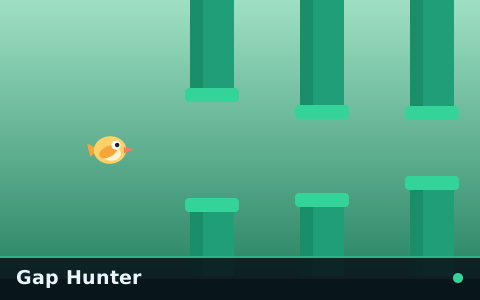
The openings shrink with every gate you pass. They stop shrinking at a width that is genuinely passable — eventually.

Boss Gate
Three stages of escalating gate patterns, then a shutter that closes on a rhythm you have to time, not react to.
Neon Flight
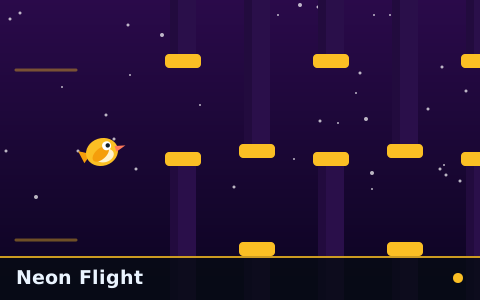
Fast from the first gate, with obstacles packed into sequences that leave almost no recovery room.