Obstacle
Pipe Escape
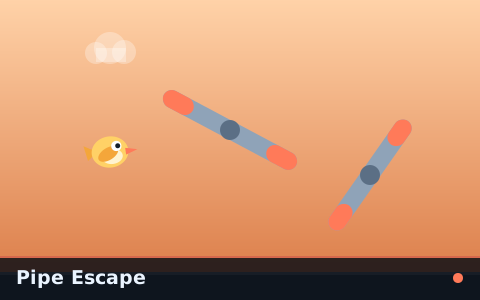
Rotating bars instead of pillars. The opening is always there — it just is not always where you are.
Boss Gate is the closest thing the genre has to a boss fight. Three stages of increasingly layered obstacle patterns lead to a single enormous mechanical gate whose shutter opens and closes on a fixed rhythm. You cannot react to it. You have to arrive on the beat.
Clear three stages of escalating obstacle patterns, then time your run through a closing shutter. Reaching a later stage is what gets recorded.
| Action | Keyboard / mouse | Touch |
|---|---|---|
| Flap | Space, W or Arrow Up | Tap anywhere on the play area |
| Pause / resume | P or Esc | Pause button in the game bar |
| Restart | R | Restart button in the game bar |
Pause with P or Esc, restart with R. The game pauses automatically if you switch tabs. More detail in keyboard controls for browser games and touch controls for arcade games.
Stage one is ordinary gates with moderate spacing. Stage two adds vertical movement to half of them. Stage three adds a second gate immediately behind the first, offset vertically, so each obstacle becomes a two-part manoeuvre with no recovery room between the halves. Each stage lasts around forty seconds and is announced clearly before it starts.
Then the shutter. It is a full-height barrier with a horizontal opening that slides closed over 1.4 seconds, stays closed for 0.9, and reopens over 1.4. The cycle never varies, which is the entire design: because it is perfectly regular, it can be counted, and because it is faster than human reaction time at the point of closure, counting is the only thing that works.
The shutter's opening also moves vertically between cycles, so you are timing two things at once — when it will be open, and where. The approach corridor before it is deliberately empty, giving you roughly four seconds to watch at least two full cycles and pick your beat.
Clearing the shutter advances you to the next loop of all three stages at a higher difficulty. The recorded result is the stage you reached, so a run that reaches the shutter and fails it still records stage four. That matters: it means progress is visible even in runs that end badly, which is the whole reason the game is structured in stages rather than as one continuous ramp.
Boss Gate uses the site's shared flight model: gravity acts continuously on your vertical velocity, a flap sets that velocity rather than adding to it, and hard caps on rise and fall speed mean no situation is ever unrecoverable. The mechanics this game leans on are Flapping, Gravity, Moving Obstacles, Timing and stages.
If you want the numbers behind that, how flappy-style games work sets out the whole model, and how flapping mechanics work explains why a flap that sets velocity behaves so differently from one that adds to it.
Chosen by shared category, mechanics and difficulty — not at random.
Rotating bars instead of pillars. The opening is always there — it just is not always where you are.
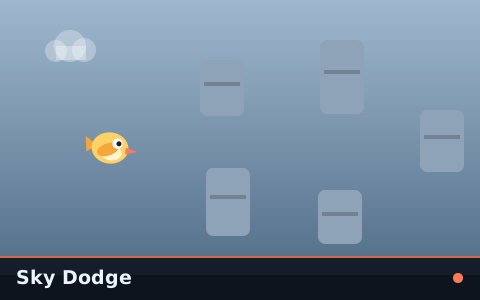
No gates at all. Free-floating barriers drift up and down, and you have to aim at where they will be.
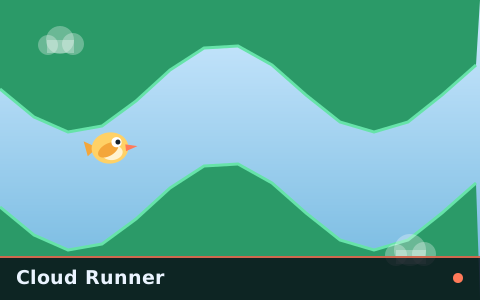
A continuous cloud corridor with no discrete gates. The walls never stop moving and neither can you.
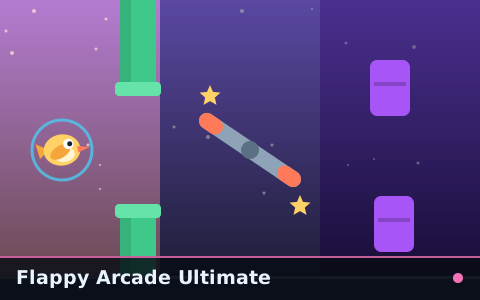
Three skies, three obstacle sets, power-ups, collectibles, a difficulty selector and a boss gate at the end of it.
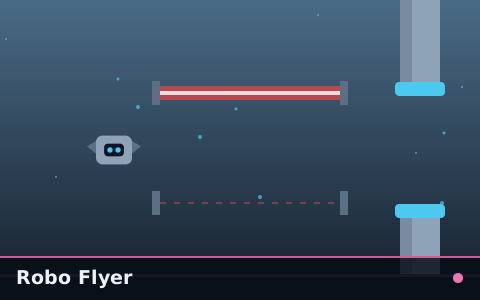
Energy beams that switch on and off on fixed cycles. The safe route is a moment rather than a place.

Cloud Runner's corridor, tighter and faster, in a tunnel that keeps closing in. Relentless, but never hidden and never unflyable.
Cornerstone Guide
Why the same flap produces completely different results depending on when you make it, what lead time actually is, and how to fix the two timing errors that end most runs.
Cornerstone Guide
Why difficulty should approach a ceiling rather than rise forever, how the four levers interact, and why the time between decisions falls faster than any individual curve.
Cornerstone Guide
What avoidance actually asks of a player, the four obstacle families and the different skills they test, and why reading two obstacles ahead changes everything.
Browse the flappy obstacle games, the full library of 30 games, or the newest additions. If you are not sure what to try next, the best flappy games to play online suggests an order.