On this page
The first ten seconds
The fastest test of a flying arcade game is whether a complete beginner survives their first ten seconds. Not whether they do well — whether they get long enough to learn what the button does.
A game that kills a new player in three seconds, five times running, has given them no information at all. A meaningful proportion of them will conclude it is broken, and given the evidence available they are not being unreasonable.
Good flying games are gentle for their opening stretch and then escalate. It is not about being easy; it is about the game keeping an implicit promise that it can be understood.
Does the hitbox match the picture?
Fly deliberately close to an obstacle and see whether a visible near miss kills you. If it does, the game is using a bounding rectangle on a rounded sprite, and every close call will feel arbitrary.
Good games use a circle for a rounded flyer and set its radius slightly smaller than the drawing — ours is about 82%. That forgiveness is what makes a near miss read as a near miss rather than a cheat.
Does difficulty have a ceiling?
Play for two or three minutes if you can. Does the game keep accelerating indefinitely, or does it settle into a hard steady state?
A game that rises forever ends every run at the same wall, which collapses the difference between a good player and an average one. A game with a ceiling lets you reach a state that used to be beyond you and hold it, which is the most satisfying thing the genre offers.
The tell is whether your best runs feel like they ended because you slipped or because the game ran out of room for you.
The rest of the checklist
- Restart in about a second, with no menu and no confirmation. Slow restarts cost attempts, and attempts are where learning happens.
- Failure is legible. You should be able to say what you did wrong. If you cannot, the game is too complex or too random.
- Nothing is hidden. Every change telegraphs, and never by colour alone.
- It pauses properly — on a key, and automatically when the tab loses focus. A game that runs while you cannot see it is not respecting your time.
- It runs the same on any monitor. If it feels twice as fast on a 144 Hz display, it is not delta-timed.
- Scoring points at the design. If the game is about accuracy, accuracy should score. Otherwise it silently endorses the thing it is not about.
Testing a game in ninety seconds
If you want to evaluate an unfamiliar flying game quickly, there is a short sequence that reveals most of what matters.
- Play it cold. How long does your first run last? Under five seconds is a warning sign.
- Fly deliberately close to something. Does a visible near miss kill you?
- Hold the button down. Does the flyer rise continuously? If so the input is on held state rather than the press edge.
- Switch tabs mid-run. Does it pause, or do you come back dead?
- Fail and restart. How many clicks and how many seconds?
Four of those five take under ten seconds each, and between them they cover input handling, collision, fairness and the retry loop — which is most of what separates a good flying game from a bad one.
Key takeaways
- A complete beginner should survive roughly ten seconds — long enough to learn what the button does.
- A circular hitbox slightly smaller than the sprite is what makes near misses feel fair.
- Difficulty with a ceiling lets skill be the variable; difficulty without one makes every run end the same way.
- Failure must be legible: if you cannot say what you did wrong, the game is too complex or too random.
Frequently asked questions
How can I tell if a game is delta-timed?
Is a hard game a bad game?
What is the single biggest red flag?

Alex Morgan
Browser Games Editor & Interactive Gaming Content Specialist
Alex Morgan is the editorial byline for everything published on Flappy Arcade — the design notes, the flight-model tuning and the strategy guides for all 30 games. More about our editorial byline.
Published · Last updated
Games mentioned in this guide
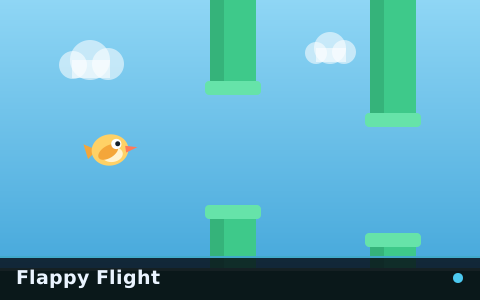
Flappy Flight
The reference flappy game: one flyer, one gap type, a speed that keeps climbing and nothing else in the way.

One-Tap Flyer
The gentlest game on the site. A floaty paper plane, wide spacing and enough time to see every decision coming.

Flappy Arcade Ultimate
Three skies, three obstacle sets, power-ups, collectibles, a difficulty selector and a boss gate at the end of it.
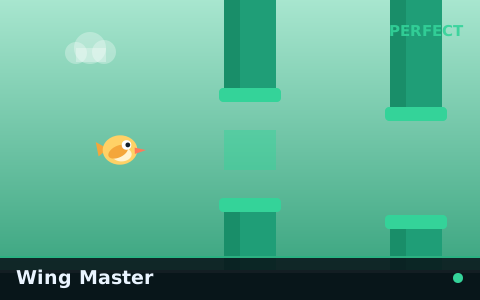
Wing Master
Scores how well you flew, not just whether you survived. The centre band of every gate is worth chasing.