Reflex
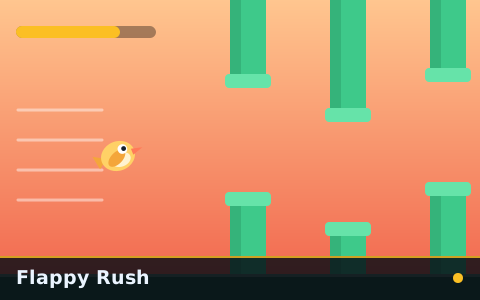
Flappy Rush
Starts readable and ends somewhere your rhythm cannot follow. A pure speed ramp with a visible speed meter.
Neon Flight is the hardest reflex game here and it does not ease you in. The field runs at full speed from the first gate, and the gates come in authored sequences — zig-zags, staircases, mirrored pairs — packed tightly enough that there is no coasting between them.
Survive authored gate sequences at full speed. Each gate scores and the combo multiplier climbs through a sequence, so completing one intact is worth far more than scraping through it.
| Action | Keyboard / mouse | Touch |
|---|---|---|
| Flap | Space, W or Arrow Up | Tap anywhere on the play area |
| Pause / resume | P or Esc | Pause button in the game bar |
| Restart | R | Restart button in the game bar |
Pause with P or Esc, restart with R. The game pauses automatically if you switch tabs. More detail in keyboard controls for browser games and touch controls for arcade games.
The interesting difference from the rest of the site is that these obstacles are not fully generated. Neon Flight draws from a set of hand-built sequences: a five-gate zig-zag, a rising staircase, a descending staircase, a mirrored pair that forces a centre line, and a run of gates at alternating extremes. Each sequence is survivable and each has a known correct line, which means the game is learnable in a way a purely random field is not.
That learnability is what makes an expert-difficulty game fair. You are not being asked to react to chaos; you are being asked to recognise a shape quickly enough to execute a line you already know. The first twenty runs are chaos. Somewhere around the thirtieth, the sequences start arriving as patterns rather than as individual gates, and the scores jump.
Between sequences there is a deliberate two-gate breather at normal spacing. It is short, but it exists, and using it properly — resetting to a central height rather than continuing the rhythm of the sequence you just finished — is most of the difference between a forty-point run and a hundred-point one.
Visually it is the darkest game on the site: a near-black sky with high-contrast neon edges on everything that matters. That is a readability decision rather than a style one. At this speed and density, the only way to keep the obstacles legible was to remove almost everything else from the screen.
Neon Flight uses the site's shared flight model: gravity acts continuously on your vertical velocity, a flap sets that velocity rather than adding to it, and hard caps on rise and fall speed mean no situation is ever unrecoverable. The mechanics this game leans on are Flapping, Gravity, Speed, Timing and narrow gaps.
If you want the numbers behind that, how flappy-style games work sets out the whole model, and how flapping mechanics work explains why a flap that sets velocity behaves so differently from one that adds to it.
Chosen by shared category, mechanics and difficulty — not at random.
Starts readable and ends somewhere your rhythm cannot follow. A pure speed ramp with a visible speed meter.
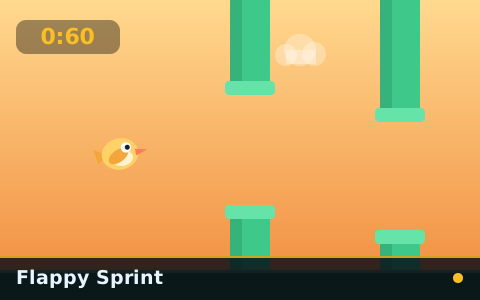
Sixty seconds, no more. Every attempt costs exactly one minute, which makes trying again almost free.

Gates that move once, mid-approach, after flashing a warning. A pure test of how fast you can change a plan.
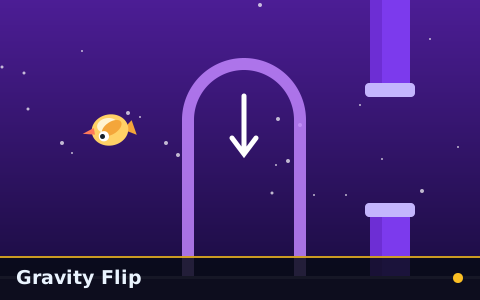
Fly through a flip gate and down becomes up. Your controls do not change — everything else does.
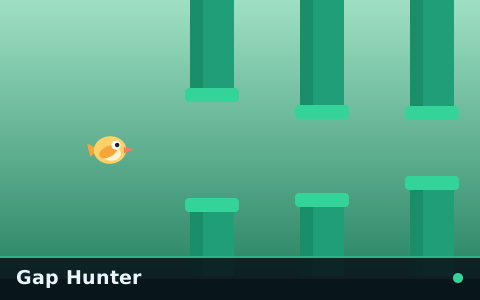
The openings shrink with every gate you pass. They stop shrinking at a width that is genuinely passable — eventually.
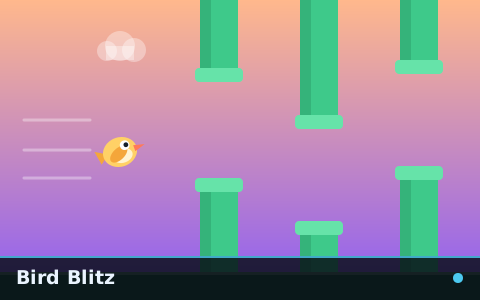
Starts where Flappy Flight finishes. A fast endless run with a speed ramp that never lets the rhythm settle.
Design
What each approach is good at, why expert difficulty almost requires authored patterns, and the hybrid that most good endless games actually use.
Cornerstone Guide
What a reflex game actually measures, the three components of reaction time and which of them practice improves, and how to get better at fast flappy games.
Mechanics
What actually changes when a flying game speeds up, why your rhythm should not, how speed and spacing compound, and where the readability limit sits.
Browse the flappy reflex games, the full library of 30 games, or the newest additions. If you are not sure what to try next, the best flappy games to play online suggests an order.