Endless
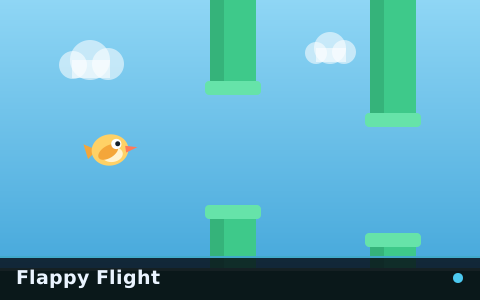
Flappy Flight
The reference flappy game: one flyer, one gap type, a speed that keeps climbing and nothing else in the way.
One-Tap Flyer is the game to start with if the genre has ever felt unfair. The flyer is a paper plane with a much floatier flight model, the gates are further apart, and the speed ramp is slow enough that you can watch a decision arrive rather than react to it.
Fly through as many gates as you can. Everything about the game is slower and more forgiving, but the scoring is the same: a point per gate, with a centre bonus and a combo multiplier.
| Action | Keyboard / mouse | Touch |
|---|---|---|
| Flap | Space, W or Arrow Up | Tap anywhere on the play area |
| Pause / resume | P or Esc | Pause button in the game bar |
| Restart | R | Restart button in the game bar |
Pause with P or Esc, restart with R. The game pauses automatically if you switch tabs. More detail in keyboard controls for browser games and touch controls for arcade games.
The flight model is the glider preset: gravity of 780, a soft flap at −300 and a terminal fall speed of only 360, with real drag applied so velocity bleeds off rather than accumulating. The result is a flyer that responds slowly and forgivingly. A mistimed flap costs you a small amount of altitude rather than the whole run.
Spacing starts at 360 units — 20% wider than the classic game — and the gaps are 240 units tall and shrink barely at all. The speed ramp tops out at 230 rather than 300. Put together, you have roughly twice as long to act on any given gate as you do in Flappy Flight, which is enough time for a beginner to plan rather than guess.
The reason it exists is that the flappy genre has an unusually steep first five minutes. Most people's first dozen attempts at a standard flappy game end in under ten seconds, and a significant number of them conclude the game is broken rather than that they are new. A gentler flight model lets the actual skill — rhythm, lead time, arriving level — be learned before the pressure arrives.
It is not a toy. The gaps do narrow, the speed does climb, and a long run still demands a steady rhythm. It is simply the version of the genre where being wrong is survivable, which makes it the best place on the site to build a habit deliberately.
One-Tap Flyer uses the site's shared flight model: gravity acts continuously on your vertical velocity, a flap sets that velocity rather than adding to it, and hard caps on rise and fall speed mean no situation is ever unrecoverable. The mechanics this game leans on are Flapping, Gravity, Timing and obstacle avoidance.
If you want the numbers behind that, how flappy-style games work sets out the whole model, and how flapping mechanics work explains why a flap that sets velocity behaves so differently from one that adds to it.
Chosen by shared category, mechanics and difficulty — not at random.
The reference flappy game: one flyer, one gap type, a speed that keeps climbing and nothing else in the way.
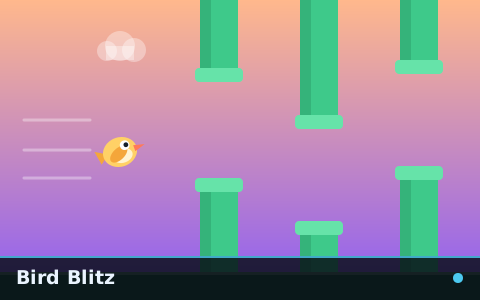
Starts where Flappy Flight finishes. A fast endless run with a speed ramp that never lets the rhythm settle.

No score, no combo, no bonuses. Just distance — a quieter endless run measured in metres rather than points.
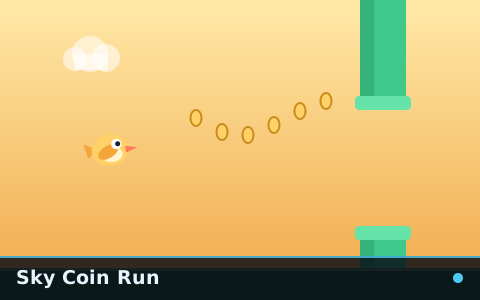
Every gate has two routes: the safe one and the one with the coins on it. They are rarely the same route.
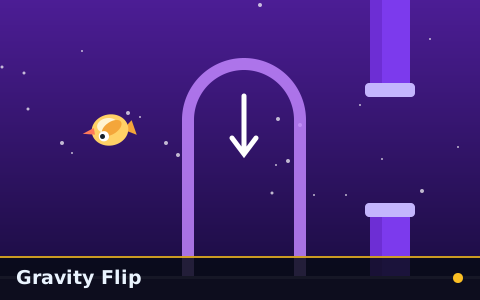
Fly through a flip gate and down becomes up. Your controls do not change — everything else does.
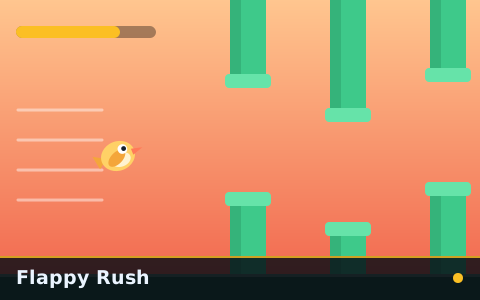
Starts readable and ends somewhere your rhythm cannot follow. A pure speed ramp with a visible speed meter.
Cornerstone Guide
Why a single input produces so much depth, what a designer gains and gives up by using one, and how one-tap games stay playable on every device without compromise.
Controls
What happens between a key press and a flap: edge detection, cooldowns, input unification across devices, and why one press must always mean exactly one flap.
Practice
The difference between playing a lot and practising, how to structure a session, and why the run that feels wasted is usually the one that taught you something.
Browse the flappy endless games, the full library of 30 games, or the newest additions. If you are not sure what to try next, the best flappy games to play online suggests an order.