Precision
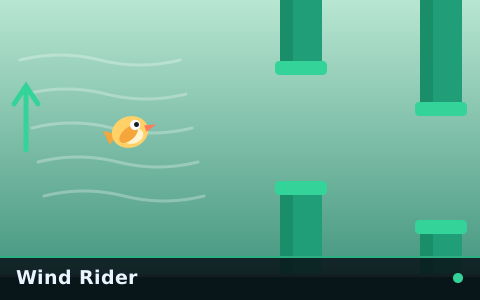
Wind Rider
A vertical wind field that changes every few seconds. The rhythm that held your height a moment ago no longer does.
Ice Flyer takes drag out of the flight model. Momentum persists: a flap keeps lifting you well after you made it, and a fall keeps falling after you have tried to stop it. Everything you know about timing still applies — it just has to happen earlier.
Fly through ice gates with a flight model that barely slows down. One point per gate, with the usual combo multiplier and centre bonus.
| Action | Keyboard / mouse | Touch |
|---|---|---|
| Flap | Space, W or Arrow Up | Tap anywhere on the play area |
| Pause / resume | P or Esc | Pause button in the game bar |
| Restart | R | Restart button in the game bar |
Pause with P or Esc, restart with R. The game pauses automatically if you switch tabs. More detail in keyboard controls for browser games and touch controls for arcade games.
Mechanically the change is small and the consequence is enormous. Rotation lag is increased, drag is reduced to almost nothing, and the flyer's response to a flap decays far more slowly than elsewhere. The practical effect is that your inputs have a much longer tail, so a double flap does not just take you higher — it takes you higher for longer.
This produces the most distinctive failure mode on the site: the delayed overshoot. You correct for a gap that is slightly high, arrive perfectly, and then keep rising into the top pillar because the momentum from your correction had not finished. Players spend their first several runs dying to the flap before last rather than the flap they just made.
The counter-intuitive fix is to flap less and earlier. On ice, a single flap made half a second sooner accomplishes what two flaps made late cannot, because the first one has time to become position rather than velocity. It is genuinely a different rhythm rather than a faster or slower version of the usual one.
Falling icicles add a second hazard from the ceiling on a slow, telegraphed schedule — each one cracks visibly for half a second before it drops. They exist to stop players from solving the ice physics by simply flying low and coasting, which would otherwise have been a valid and very boring strategy.
Ice Flyer uses the site's shared flight model: gravity acts continuously on your vertical velocity, a flap sets that velocity rather than adding to it, and hard caps on rise and fall speed mean no situation is ever unrecoverable. The mechanics this game leans on are Flapping, Gravity, Momentum and narrow gaps.
If you want the numbers behind that, how flappy-style games work sets out the whole model, and how flapping mechanics work explains why a flap that sets velocity behaves so differently from one that adds to it.
Chosen by shared category, mechanics and difficulty — not at random.
A vertical wind field that changes every few seconds. The rhythm that held your height a moment ago no longer does.
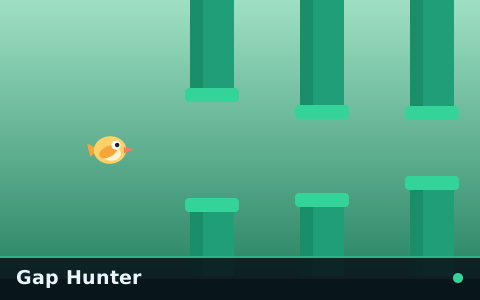
The openings shrink with every gate you pass. They stop shrinking at a width that is genuinely passable — eventually.
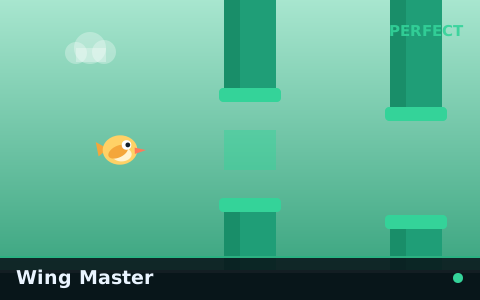
Scores how well you flew, not just whether you survived. The centre band of every gate is worth chasing.
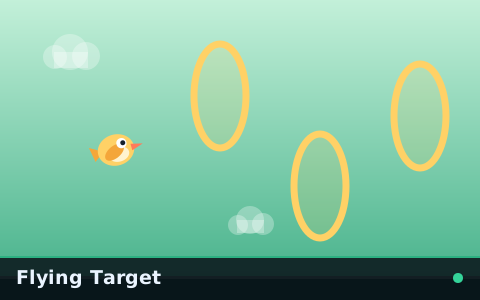
There is nothing to avoid. There are only rings to fly through, and missing one costs you.

Cloud Runner's corridor, tighter and faster, in a tunnel that keeps closing in. Relentless, but never hidden and never unflyable.
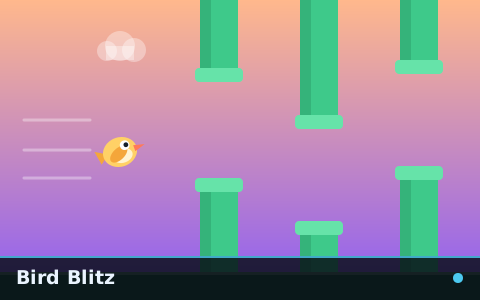
Starts where Flappy Flight finishes. A fast endless run with a speed ramp that never lets the rhythm settle.
Mechanics
What changing gravity does to a flying game in practice: decision time, rhythm, the danger surface, and why low gravity is usually more dangerous than high.
Technique
Why a narrow gap entered level is easier than a wide one entered diagonally, how to stop over-correcting, and when a gap that feels impossible genuinely is not.
Cornerstone Guide
What actually happens when you flap: impulse versus accumulation, cooldowns, rotation lag, the feel of different flap forces, and why the wing animation matters.
Browse the flappy precision games, the full library of 30 games, or the newest additions. If you are not sure what to try next, the best flappy games to play online suggests an order.