
Precision
Ice Flyer
Almost no drag. Momentum carries far past the flap that caused it, and every correction arrives late.
Wind Rider adds a vertical wind field that changes every few seconds. It is always shown — an indicator on the left edge gives direction and strength, and streaming lines across the sky show it too — but knowing about it and flying in it are different things.
Fly through gates in a shifting vertical wind field. Score is one point per gate with the usual combo multiplier; the wind indicator tells you what is coming.
| Action | Keyboard / mouse | Touch |
|---|---|---|
| Flap | Space, W or Arrow Up | Tap anywhere on the play area |
| Pause / resume | P or Esc | Pause button in the game bar |
| Restart | R | Restart button in the game bar |
Pause with P or Esc, restart with R. The game pauses automatically if you switch tabs. More detail in keyboard controls for browser games and touch controls for arcade games.
Every other game on the site has a fixed neutral rhythm: a flap frequency that holds a constant height. Finding it is the first thing a player learns. Wind Rider changes it continuously, which means the skill being tested is not whether you found the rhythm but whether you can find a new one in about a second.
The wind is a vertical acceleration added to gravity, ranging up to 700 units per second squared in either direction, and it eases between values rather than snapping. Gusts last between two and five seconds. A strong upward gust roughly halves your effective gravity; a strong downward gust roughly doubles it. Neither ever makes a flap useless — the flap impulse always exceeds what the wind can do in the time it takes to cross a gate.
Because the wind is always visible, the correct play is to read the indicator and pre-adjust rather than to feel the change and correct. Players who watch the indicator improve here almost immediately; players who ignore it plateau quickly, and it is one of the clearest demonstrations on the site that reading beats reacting.
Gaps are moderate and the speed ramp is gentle, because the wind is the difficulty. There is a brief calm period at the start of every run so you can establish the still-air rhythm before anything starts pushing you around.
Wind Rider uses the site's shared flight model: gravity acts continuously on your vertical velocity, a flap sets that velocity rather than adding to it, and hard caps on rise and fall speed mean no situation is ever unrecoverable. The mechanics this game leans on are Flapping, Gravity, Wind and narrow gaps.
If you want the numbers behind that, how flappy-style games work sets out the whole model, and how flapping mechanics work explains why a flap that sets velocity behaves so differently from one that adds to it.
Chosen by shared category, mechanics and difficulty — not at random.
Almost no drag. Momentum carries far past the flap that caused it, and every correction arrives late.
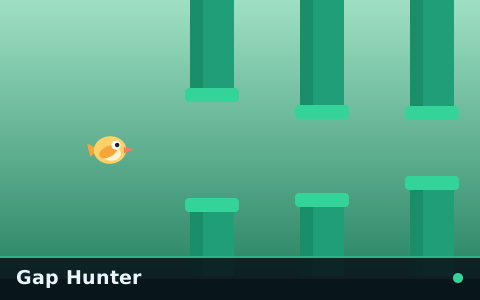
The openings shrink with every gate you pass. They stop shrinking at a width that is genuinely passable — eventually.
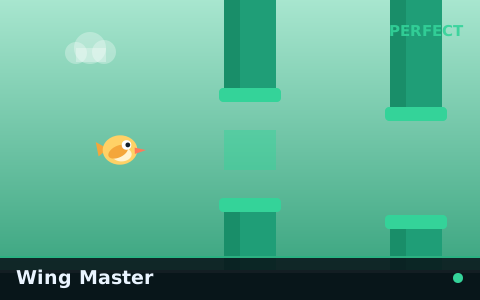
Scores how well you flew, not just whether you survived. The centre band of every gate is worth chasing.
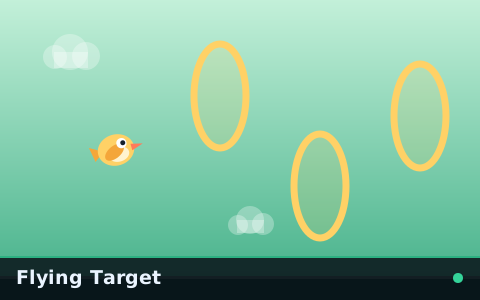
There is nothing to avoid. There are only rings to fly through, and missing one costs you.

Cloud Runner's corridor, tighter and faster, in a tunnel that keeps closing in. Relentless, but never hidden and never unflyable.
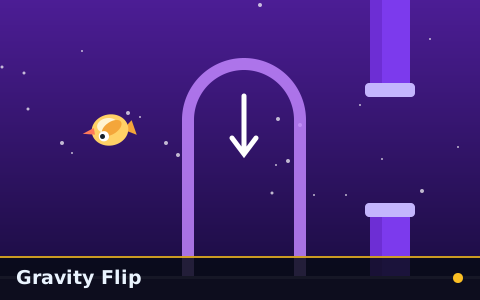
Fly through a flip gate and down becomes up. Your controls do not change — everything else does.
Mechanics
What changing gravity does to a flying game in practice: decision time, rhythm, the danger surface, and why low gravity is usually more dangerous than high.
Cornerstone Guide
Why precision is a separate skill from speed, how narrow a gap can fairly be, what perfect-pass scoring is for, and the three-step method for controlling altitude.
Cornerstone Guide
What arcade gravity actually is, why it is not the real thing, how terminal velocity and buoyancy change a game's feel, and what happens when you alter gravity mid-run.
Browse the flappy precision games, the full library of 30 games, or the newest additions. If you are not sure what to try next, the best flappy games to play online suggests an order.