
Precision is a different skill from speed
It is tempting to treat precision as just "harder", but it draws on something separate. A reflex game asks how quickly you can convert what you see into an input. A precision game asks how accurately you can predict what an input will do — where exactly the flyer will be half a second after a flap, given the velocity it already has.
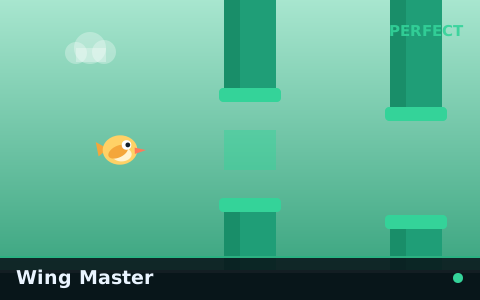
That prediction is learnable in a way that reaction speed is not, and it improves faster than most players expect. Within about twenty minutes on Wing Master, most people stop over-flapping and start arriving at gaps flat rather than climbing or diving. The score change is usually dramatic, because a flat arrival makes a narrow gap barely harder than a wide one.
The corollary is that precision games are often the best training for the rest of the site. Nothing improves an endless run faster than learning to arrive at gaps level.
Perfect passes and why we score them
Three of these games award a bonus for passing close to the centre of a gap rather than merely inside it. That mechanic exists for a specific reason: without it, a precision game gives you no feedback at all about how well you flew, only whether you survived.
A near-miss and a clean centre pass score identically in an ordinary flappy game, which means the game silently endorses the near miss. Scoring the centre turns every gate into a piece of feedback, and the feedback arrives immediately — while you can still remember what you did.
- Inside the gap — base points, combo continues.
- Within the central band — bonus points and a distinct sound.
- Consecutive perfect passes — the combo multiplier climbs faster.
The practical effect is that a cautious player who threads centres outscores an aggressive one who scrapes edges, even if both survive the same length of time. That is deliberate.
How narrow is too narrow?
Every gap in every game on this site is checked against the same floor: the opening must be at least large enough for the flyer's body plus room for one correction at the current fall speed. In practice that works out at roughly two and a half times the flyer's diameter at the hardest settings.
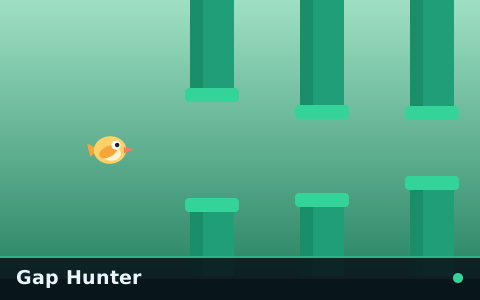
Below that, a gap stops being a test of accuracy and becomes a test of whether your flap happened to land on the right frame — which feels arbitrary even when it is technically possible. Gap Hunter shrinks its openings continuously and is the game that comes closest to the floor; it stops shrinking well before it reaches it, and the last few gaps are genuinely passable by a steady player.
If a gap ever feels impossible rather than merely hard, the useful question is whether you arrived at it level. Almost every "impossible" gap turns out to have been entered while already climbing or already falling.
Altitude control, in three steps
- Find the neutral rhythm. Every flight model has a flap frequency that holds a roughly constant height. Find it in the first few seconds of a run by flapping steadily and watching whether you drift up or down.
- Move between heights deliberately. To climb, add one extra flap to the rhythm — not three. To descend, skip one. Large changes are far harder to stop than they are to start.
- Arrive early and hold. Reach the height a gap needs before you get to it, then maintain. A gap entered flat is forgiving; a gap entered mid-correction is not.
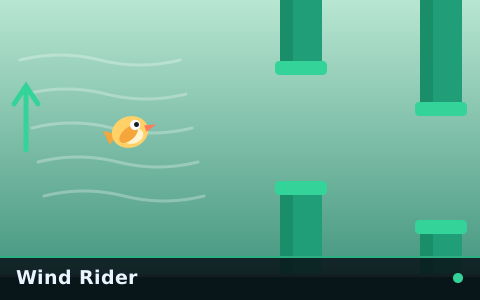
That sequence is the whole of precision flying, and it is the thing Wind Rider exists to break — its gusts change the neutral rhythm while you are using it, which is an excellent way to find out whether you learned the principle or just the numbers.
Quick tips for flappy precision games
- Learn the flap rhythm that holds a constant height before you try to be accurate about anything else.
- Change altitude with one extra flap or one skipped flap, never with a burst.
- Arrive at a gap already level. Most "impossible" gaps were entered mid-correction.
- Aim for the centre even when the edge would do — perfect passes score more and leave room for error.
- If you keep clipping the bottom, you are flapping late; if you keep clipping the top, you are flapping twice.