Reflex
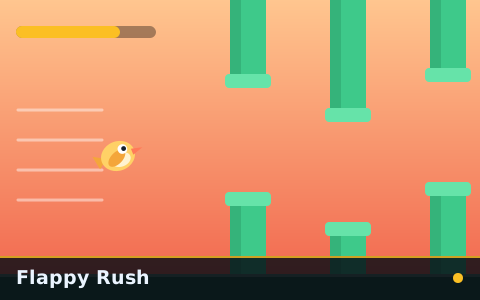
Flappy Rush
Starts readable and ends somewhere your rhythm cannot follow. A pure speed ramp with a visible speed meter.
Gravity Flip puts inversion gates in the field. Pass through one and gravity reverses: the flyer falls toward the ceiling, and a flap pushes it toward the floor. The button does not change. What it does changes completely, and your hands take a second to believe it.
Keep flying while gravity reverses. Ordinary gates score one point each; flip gates award a bonus for getting through the inversion intact.
| Action | Keyboard / mouse | Touch |
|---|---|---|
| Flap | Space, W or Arrow Up | Tap anywhere on the play area |
| Pause / resume | P or Esc | Pause button in the game bar |
| Restart | R | Restart button in the game bar |
Pause with P or Esc, restart with R. The game pauses automatically if you switch tabs. More detail in keyboard controls for browser games and touch controls for arcade games.
The mechanic works because flapping is such deeply ingrained muscle memory by the time you get here. Everything else on this site trains one association — press means up — and inverting it produces a genuinely involuntary error for the first few seconds. Watching a new player hit a flip gate is watching them flap themselves straight into the floor while knowing exactly what they are doing wrong.
The adaptation is fast, though, and that is the interesting part. Most players need about three seconds after their first flip and under a second after their tenth. What is being trained is not a new skill but the ability to switch between two mappings quickly — and that improves much faster than most gaming skills do.
Flip gates are visually unmistakable: a wide purple arch with an arrow showing the direction gravity will point after you pass through. Both the floor and the ceiling are solid surfaces, the one you are currently falling toward is drawn brighter than the other, and a readout in the top-left states the current direction in words. Nothing about the state you are in is ambiguous.
Flips are spaced with an eight-second minimum, so you are never flipped twice before you have settled. Ordinary gates continue between them at normal density. The scoring is standard — a point per gate — but flip gates themselves award a bonus, because surviving the first two seconds after one is genuinely the hard part of the game.
Gravity Flip uses the site's shared flight model: gravity acts continuously on your vertical velocity, a flap sets that velocity rather than adding to it, and hard caps on rise and fall speed mean no situation is ever unrecoverable. The mechanics this game leans on are Flapping, Gravity, Timing and obstacle avoidance.
If you want the numbers behind that, how flappy-style games work sets out the whole model, and how flapping mechanics work explains why a flap that sets velocity behaves so differently from one that adds to it.
Chosen by shared category, mechanics and difficulty — not at random.
Starts readable and ends somewhere your rhythm cannot follow. A pure speed ramp with a visible speed meter.

Gates that move once, mid-approach, after flashing a warning. A pure test of how fast you can change a plan.
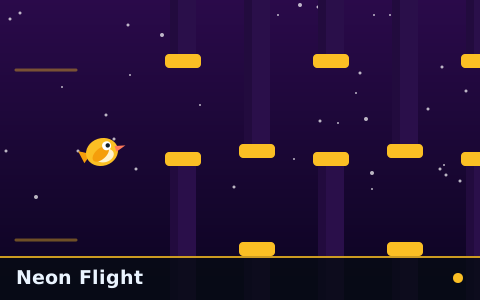
Fast from the first gate, with obstacles packed into sequences that leave almost no recovery room.
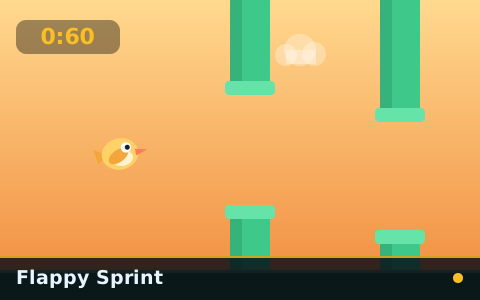
Sixty seconds, no more. Every attempt costs exactly one minute, which makes trying again almost free.
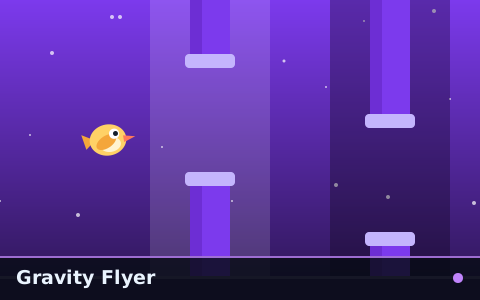
Coloured zones change how heavy you are. Same button, same gates, three completely different flight models.
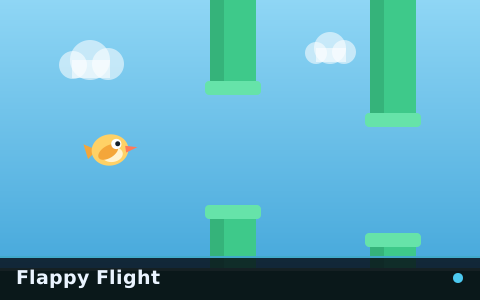
The reference flappy game: one flyer, one gap type, a speed that keeps climbing and nothing else in the way.
Cornerstone Guide
What arcade gravity actually is, why it is not the real thing, how terminal velocity and buoyancy change a game's feel, and what happens when you alter gravity mid-run.
Mechanics
What changing gravity does to a flying game in practice: decision time, rhythm, the danger surface, and why low gravity is usually more dangerous than high.
Cornerstone Guide
What a reflex game actually measures, the three components of reaction time and which of them practice improves, and how to get better at fast flappy games.
Browse the flappy reflex games, the full library of 30 games, or the newest additions. If you are not sure what to try next, the best flappy games to play online suggests an order.