On this page
Speed does not change your rhythm
The most common misconception in the genre is that a faster game requires faster flapping. It does not, and acting on that belief is actively harmful.
Gravity is unaffected by how fast the world scrolls past you. The flap frequency that holds a constant height at 180 units per second holds exactly the same height at 340. Nothing about your vertical behaviour needs to change at all.
What changes is when you must act. A 60-unit altitude change takes about a third of a second regardless of scroll speed — but at 180 units per second that third of a second is 60 units of horizontal distance, and at 340 it is 113. Your lead has to nearly double while your rhythm stays identical.
Speed and spacing compound
The subtler effect is that speed interacts with spacing, and the interaction is stronger than either looks.
| Stage | Spacing | Speed | Time between decisions |
|---|---|---|---|
| Start | 300 | 172 | 1.74 s |
| Mid-run | 255 | 240 | 1.06 s |
| Ceiling | 210 | 300 | 0.70 s |
Spacing falls 30%, speed rises 74%, and the time between decisions falls 60%. The player experiences the derived quantity, not the inputs, which is why a difficulty curve that looks gentle on paper can feel brutal in play.
The design response is to tune against decision interval directly. Sky Dodge actually widens its spacing as its obstacles start moving more, because movement needs more reading time, not less.
The readability limit
Speed has no hard physical ceiling the way gap size does, but it has a practical one: the point at which the field cannot be read at all.
Roughly, a player needs about 0.4 seconds between the moment an obstacle becomes legible and the moment they must act on it. Below that, no amount of skill helps — you are inside perception plus execution time.
That limit is why the fastest games here are also the ones with the most generous gaps and, in Neon Flight's case, authored patterns. If you are going to spend the player's reading budget on speed, you cannot also spend it on novelty and accuracy.
Adjusting as speed rises
- Keep the rhythm. Do not flap faster. Gravity has not changed.
- Move your eyes earlier. Watch where obstacles enter the screen rather than where they reach you.
- Commit sooner. Move your reference line further from the flyer.
- Take safer lines. At speed, the centre bonus is worth less than the margin.
- Expect a wall, then push past it. Most players have a speed at which they die repeatedly. That is a reading limit, not a skill ceiling, and it moves with practice.
Speed and confidence
There is a psychological effect that shows up consistently at high scroll speeds and is worth naming because it is treatable.
As speed rises, players start making smaller, more frequent corrections — not because the game requires them but because uncertainty feels like it should be answered with action. The result is a flyer that is never settled, which is precisely the state in which gaps are hardest to enter.
The counter is to deliberately commit to fewer, earlier decisions as the speed climbs: pick the height, go there, hold. It feels reckless at high speed and it is measurably better than continuous adjustment. If you watch a strong player at the ceiling speed of Flappy Rush, the most striking thing is how little they are doing.
Key takeaways
- Speed changes lead time, not rhythm — gravity is unaffected by how fast the world scrolls.
- Spacing and speed compound: a 30% spacing cut plus a 74% speed rise halves decision time and more.
- The practical speed ceiling is readability — roughly 0.4 seconds between legibility and action.
- If you spend the reading budget on speed, you cannot also spend it on novelty and accuracy.
- At high speed, commit to fewer and earlier decisions; continuous small corrections leave the flyer never settled.
Frequently asked questions
Should I flap faster when the game speeds up?
Why does a small speed increase feel so large?
Is there a maximum usable speed?

Alex Morgan
Browser Games Editor & Interactive Gaming Content Specialist
Alex Morgan is the editorial byline for everything published on Flappy Arcade — the design notes, the flight-model tuning and the strategy guides for all 30 games. More about our editorial byline.
Published · Last updated
Games mentioned in this guide

Flappy Rush
Starts readable and ends somewhere your rhythm cannot follow. A pure speed ramp with a visible speed meter.
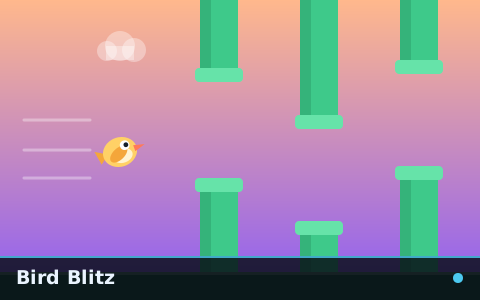
Bird Blitz
Starts where Flappy Flight finishes. A fast endless run with a speed ramp that never lets the rhythm settle.

Neon Flight
Fast from the first gate, with obstacles packed into sequences that leave almost no recovery room.

Sky Tunnel
Cloud Runner's corridor, tighter and faster, in a tunnel that keeps closing in. Relentless, but never hidden and never unflyable.