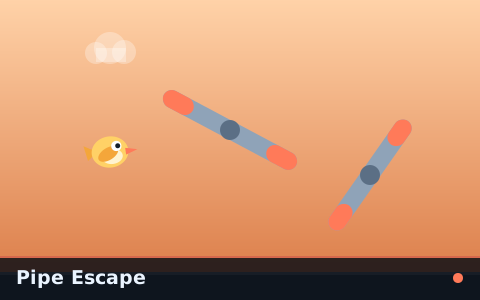
Obstacle
Pipe Escape
Rotating bars instead of pillars. The opening is always there — it just is not always where you are.
Sky Dodge removes gates entirely. What comes at you instead is a field of free-floating barriers, each drifting vertically on its own cycle, and the gap between them is wherever they happen not to be. It is the site's introduction to prediction rather than reaction.
Weave through drifting barrier columns for as long as you can. One point per column cleared, with the usual combo multiplier for consecutive clean passes.
| Action | Keyboard / mouse | Touch |
|---|---|---|
| Flap | Space, W or Arrow Up | Tap anywhere on the play area |
| Pause / resume | P or Esc | Pause button in the game bar |
| Restart | R | Restart button in the game bar |
Pause with P or Esc, restart with R. The game pauses automatically if you switch tabs. More detail in keyboard controls for browser games and touch controls for arcade games.
Barriers arrive in loose columns of two or three, each one drifting up and down on a sine cycle with its own amplitude, period and starting phase. Nothing is synchronised, which means the shape of the opening between them changes continuously as the column approaches. The line that was safe when the column appeared is frequently not the line that is safe when you reach it.
The skill that makes the difference is refusing to chase. New players follow a barrier as it rises, then follow it down as it falls, and arrive permanently one beat behind — which is the worst possible position because they are always moving in the direction the obstacle is about to vacate. The alternative is to pick the position the opening will be in when you get there, fly to that height early, and hold it while the column comes to you.
Barriers never move fast enough to close a gap entirely and never drift far enough to reach the ceiling or the floor. Every column has a survivable line at every moment of its cycle, and the horizontal spacing is set so that at least one full period of each barrier's movement is visible before you have to commit. Those two constraints are what keep the game a prediction test rather than a guessing game.
Drift amplitude and speed both climb with the run, so late columns swing further and faster. The spacing between columns increases very slightly to compensate, which is a deliberate counterweight: more movement needs more time to read, not less.
Sky Dodge uses the site's shared flight model: gravity acts continuously on your vertical velocity, a flap sets that velocity rather than adding to it, and hard caps on rise and fall speed mean no situation is ever unrecoverable. The mechanics this game leans on are Flapping, Gravity, Moving Obstacles and prediction.
If you want the numbers behind that, how flappy-style games work sets out the whole model, and how flapping mechanics work explains why a flap that sets velocity behaves so differently from one that adds to it.
Chosen by shared category, mechanics and difficulty — not at random.
Rotating bars instead of pillars. The opening is always there — it just is not always where you are.
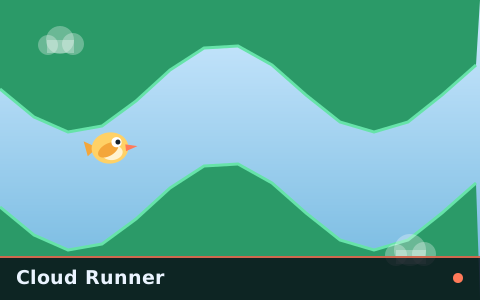
A continuous cloud corridor with no discrete gates. The walls never stop moving and neither can you.

Three stages of escalating gate patterns, then a shutter that closes on a rhythm you have to time, not react to.

Cloud Runner's corridor, tighter and faster, in a tunnel that keeps closing in. Relentless, but never hidden and never unflyable.

Gates that move once, mid-approach, after flashing a warning. A pure test of how fast you can change a plan.
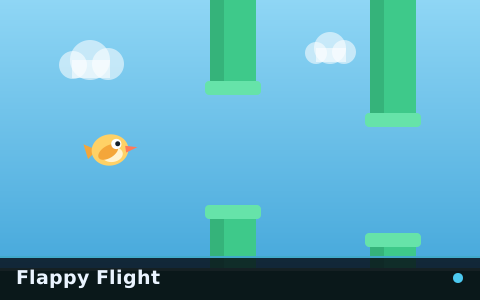
The reference flappy game: one flyer, one gap type, a speed that keeps climbing and nothing else in the way.
Technique
Why chasing a moving obstacle puts you permanently one beat behind, how to read a drift cycle, and the difference between predicting and reacting.
Cornerstone Guide
What avoidance actually asks of a player, the four obstacle families and the different skills they test, and why reading two obstacles ahead changes everything.
Design
What each approach is good at, why expert difficulty almost requires authored patterns, and the hybrid that most good endless games actually use.
Browse the flappy obstacle games, the full library of 30 games, or the newest additions. If you are not sure what to try next, the best flappy games to play online suggests an order.