
Reflex
Sky Reflex
Gates that move once, mid-approach, after flashing a warning. A pure test of how fast you can change a plan.
Flappy Rush is one idea taken all the way: speed. It begins at a comfortable pace and accelerates steadily for as long as you survive, with a speed meter on screen so you can watch the number that is about to beat you. The obstacles never get cleverer. They just arrive sooner.
Survive an accelerating field for as long as possible. One point per gate with the usual combo multiplier; the speed meter shows exactly what you are up against.
| Action | Keyboard / mouse | Touch |
|---|---|---|
| Flap | Space, W or Arrow Up | Tap anywhere on the play area |
| Pause / resume | P or Esc | Pause button in the game bar |
| Restart | R | Restart button in the game bar |
Pause with P or Esc, restart with R. The game pauses automatically if you switch tabs. More detail in keyboard controls for browser games and touch controls for arcade games.
The reason the game shows its speed is that most players cannot tell how fast they are going. Acceleration this gradual is invisible from inside — you simply notice, at some point, that your flaps are landing late. Putting the number on screen turns that into information you can act on, and it changes how people play almost immediately.
What you are supposed to do with it is adjust lead time rather than flap rate. The rhythm that holds altitude does not change with scroll speed — gravity is unaffected by how fast the world moves past you. What changes is how far ahead you have to make each decision. At 180 units per second you can decide about a gate when it is halfway across the screen; at 340 you have to have decided before it appeared.
The speed ramp is linear rather than asymptotic for the first ninety seconds, which is unusual for this site and is the reason this game is in the reflex category rather than the endless one. After ninety seconds it does flatten — the ceiling is 360 units per second, about double the starting speed — but the ninety seconds before that are a genuinely continuous escalation.
Gaps are generous throughout and barely narrow at all. This is deliberate: stacking a precision test on top of a speed test produces a game that is hard for two reasons at once and teaches you nothing about either. Here, if you die, it was the speed.
Flappy Rush uses the site's shared flight model: gravity acts continuously on your vertical velocity, a flap sets that velocity rather than adding to it, and hard caps on rise and fall speed mean no situation is ever unrecoverable. The mechanics this game leans on are Flapping, Gravity, Speed and timing.
If you want the numbers behind that, how flappy-style games work sets out the whole model, and how flapping mechanics work explains why a flap that sets velocity behaves so differently from one that adds to it.
Chosen by shared category, mechanics and difficulty — not at random.
Gates that move once, mid-approach, after flashing a warning. A pure test of how fast you can change a plan.
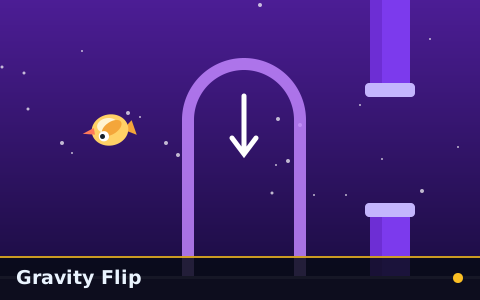
Fly through a flip gate and down becomes up. Your controls do not change — everything else does.
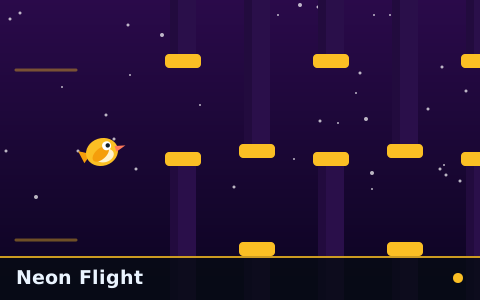
Fast from the first gate, with obstacles packed into sequences that leave almost no recovery room.
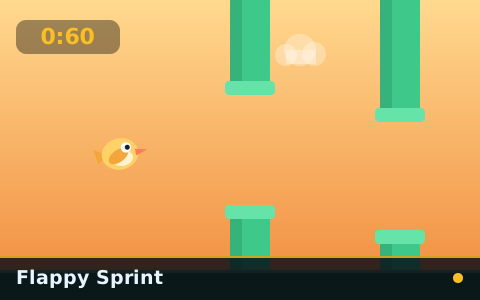
Sixty seconds, no more. Every attempt costs exactly one minute, which makes trying again almost free.
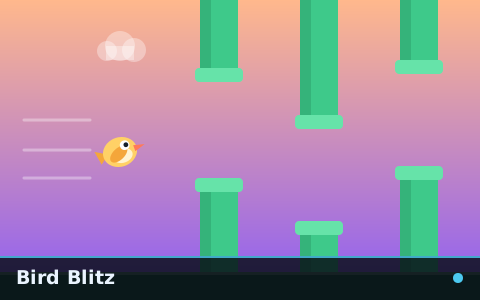
Starts where Flappy Flight finishes. A fast endless run with a speed ramp that never lets the rhythm settle.
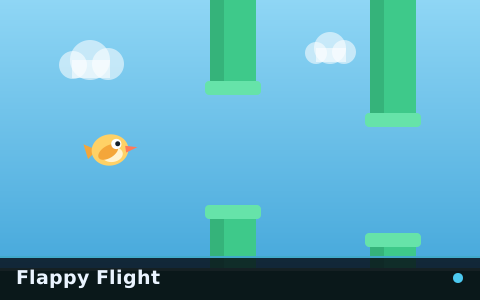
The reference flappy game: one flyer, one gap type, a speed that keeps climbing and nothing else in the way.
Cornerstone Guide
What a reflex game actually measures, the three components of reaction time and which of them practice improves, and how to get better at fast flappy games.
Mechanics
What actually changes when a flying game speeds up, why your rhythm should not, how speed and spacing compound, and where the readability limit sits.
Cornerstone Guide
What can and cannot be trained, why recognition beats raw speed, where to look, and a practice routine that produces measurable improvement in a few sessions.
Browse the flappy reflex games, the full library of 30 games, or the newest additions. If you are not sure what to try next, the best flappy games to play online suggests an order.