On this page
Consistency is not accuracy
These two get confused constantly. Accuracy is hitting the gap. Consistency is hitting it the same way every time — and the second is what actually raises a score, because an inconsistent player is accurate on average and dead on the third gate.
The reason consistency is hard is that most players make a fresh judgement at every obstacle. Judgements vary. They vary more when you are tired, more when you are nervous, and more when the previous gate was a near miss. Every source of variance you can remove is score you get back for free.
Build a reference line
The fix is to stop judging and start triggering. Pick a vertical position on the screen — roughly two-thirds of the way across is a good default — and commit to your altitude change the moment a gate crosses it. Every time, regardless of how the gate looks.
That converts "does this feel close enough yet?" into "has it crossed the line?", which is a much simpler question and a much more repeatable one. It also has the useful property of being self-correcting: if you are consistently early or late, you move the line rather than changing your whole technique.
- Play a run with the line deliberately in mind, saying "now" to yourself as each gate crosses it.
- Notice which half of the gap you tend to arrive at.
- Move the line forward if you arrive low, back if you arrive high.
- Repeat until your arrivals cluster around the centre.
Diagnose early versus late
There is a reliable tell and it takes three runs to read.
| Where you die | Cause | Adjustment |
|---|---|---|
| Bottom half of gates | Flapping late | Move the reference line earlier |
| Top half of gates | Flapping twice | Add a deliberate pause after each flap |
| The ceiling | Panic flapping | Skip one flap after every near miss |
| The floor | Waiting for certainty | Trigger on the line, not on confidence |
Almost nobody spreads evenly across all four. Whichever dominates is the one to fix, and fixing it usually buys more than any other change you could make.
The rhythm underneath
A reference line handles gates. Between them, what keeps you stable is a steady baseline rhythm — the flap frequency that holds a constant height in that particular flight model.
Find it in the first seconds of every run by flapping steadily and watching whether you drift. Then change altitude by adding exactly one flap or skipping exactly one, never by bursting. Bursts are easy to start and hard to stop, and every burst buys you an overshoot to correct.
This is also why switching games resets part of your timing. The rhythm is a property of the flight model, so Ice Flyer and Bird Blitz need different baselines. Fly a few seconds of open sky before you start counting.
Key takeaways
- Consistency, not accuracy, is what raises scores — an inconsistent player is accurate on average and dead on the third gate.
- Replace per-gate judgements with a fixed reference line and trigger on it every time.
- Bottom-half deaths mean late flaps; top-half deaths mean double flaps.
- Find the baseline rhythm at the start of every run, and change altitude in single steps.
Frequently asked questions
Where should I put my reference line?
Does the same reference line work in every game?
Why does my timing fall apart when I am doing well?

Alex Morgan
Browser Games Editor & Interactive Gaming Content Specialist
Alex Morgan is the editorial byline for everything published on Flappy Arcade — the design notes, the flight-model tuning and the strategy guides for all 30 games. More about our editorial byline.
Published · Last updated
Games mentioned in this guide

Flappy Flight
The reference flappy game: one flyer, one gap type, a speed that keeps climbing and nothing else in the way.
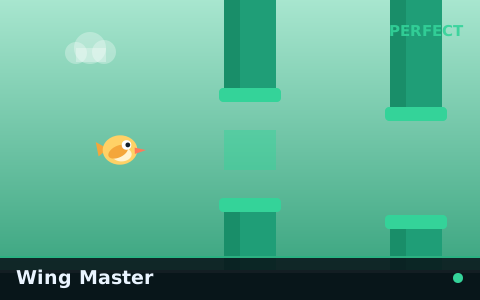
Wing Master
Scores how well you flew, not just whether you survived. The centre band of every gate is worth chasing.
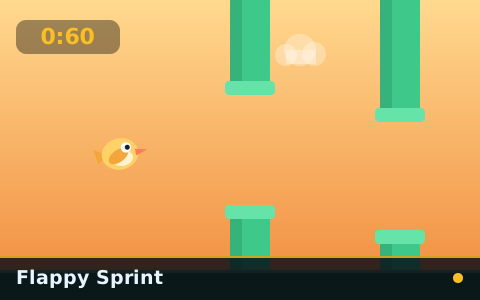
Flappy Sprint
Sixty seconds, no more. Every attempt costs exactly one minute, which makes trying again almost free.