On this page
Chasing is the mistake
Almost every player's first instinct against a drifting obstacle is to follow it. The barrier rises, you rise; it falls, you fall. It feels responsive and it is the worst available strategy.
The reason is lag. By the time you have observed the movement, decided and flapped, the obstacle has moved on — so you are always arriving where it was, which is precisely the space it is vacating and then returning to. Chasing puts you in phase with the danger rather than out of it.
Following a moving obstacle puts you where it was. The only useful question is where it will be.
Read the cycle instead
Moving obstacles in a well-built game oscillate on a period, and the period is visible before you have to commit — in ours, at least one full cycle.
- Note the direction it is travelling when it appears.
- Estimate your arrival — roughly how long until you reach it.
- Predict its position at that moment, not now.
- Fly there early and hold.
Step four is what makes it work. Once you are at the predicted height, stop adjusting. Let the obstacle come to you. Every correction after that point is a re-introduction of the chasing problem.
Obstacles moving apart versus together
A quick heuristic for reading a column of movers: watch whether the gap between two of them is opening or closing.
A gap that is opening is an opportunity that will be larger when you get there, so you can commit early and confidently. A gap that is closing is a trap — it will be smaller on arrival than it looks now, and the correct response is usually to find a different line rather than to hurry.
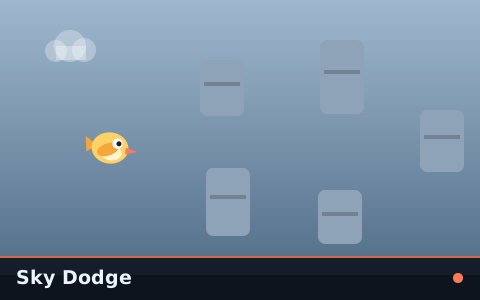
In Sky Dodge, where barriers drift on independent cycles, that single observation is most of the skill. Columns whose members are separating are safe to fly through the middle of; columns converging should be taken above or below.
Timed obstacles are a different problem
A beam that switches on and off, or a shutter that closes on a cycle, is not a moving obstacle in this sense — it is a timed one, and prediction is replaced by counting.
The distinction matters because the correct technique inverts. Against a drifting barrier you position early and hold. Against a timed hazard you often need to wait — hovering deliberately in front of it until the safe phase arrives.
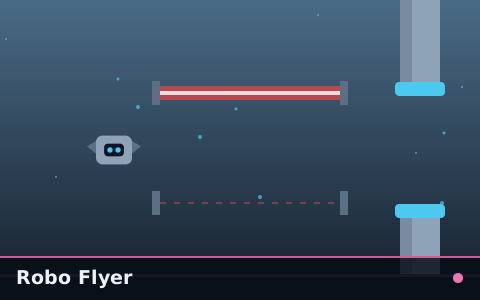
Waiting feels like failure and is frequently optimal. In Robo Flyer, the single biggest improvement most players make is being willing to hold position for half a second before a beam rather than trying to squeeze through the edge of one.
Key takeaways
- Chasing a moving obstacle puts you in phase with the danger; predict where it will be instead.
- Fly to the predicted height early and then stop adjusting — let the obstacle come to you.
- A gap that is opening is safe to commit to; a gap that is closing will be smaller on arrival than it looks.
- Timed hazards need counting and patience rather than prediction — waiting is often the correct play.
Frequently asked questions
How do I know where an obstacle will be when I arrive?
Why do I keep dying to barriers I just passed?
Is it ever right to just wait in front of an obstacle?

Alex Morgan
Browser Games Editor & Interactive Gaming Content Specialist
Alex Morgan is the editorial byline for everything published on Flappy Arcade — the design notes, the flight-model tuning and the strategy guides for all 30 games. More about our editorial byline.
Published · Last updated
Games mentioned in this guide
Sky Dodge
No gates at all. Free-floating barriers drift up and down, and you have to aim at where they will be.
Pipe Escape
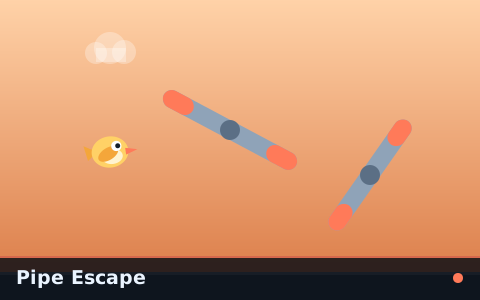
Rotating bars instead of pillars. The opening is always there — it just is not always where you are.
Robo Flyer
Energy beams that switch on and off on fixed cycles. The safe route is a moment rather than a place.

Sky Reflex
Gates that move once, mid-approach, after flashing a warning. A pure test of how fast you can change a plan.