
Adventure
Flappy Arcade Ultimate
Three skies, three obstacle sets, power-ups, collectibles, a difficulty selector and a boss gate at the end of it.
Robo Flyer is about timing rather than position. The obstacles are horizontal energy beams that switch on and off on fixed cycles, and a beam that is lethal now will be harmless in a moment. Getting through means arriving at the right time, not finding the right height.
Cross a robotics bay where energy beams cycle on and off. Beams cleared and gates passed both score, and the beam cycles repeat so every section is learnable.
| Action | Keyboard / mouse | Touch |
|---|---|---|
| Flap | Space, W or Arrow Up | Tap anywhere on the play area |
| Pause / resume | P or Esc | Pause button in the game bar |
| Restart | R | Restart button in the game bar |
Pause with P or Esc, restart with R. The game pauses automatically if you switch tabs. More detail in keyboard controls for browser games and touch controls for arcade games.
A timed hazard is a fundamentally different skill from a positional one, and it is the skill the rest of the site uses least. Everywhere else, the question is where the safe space is. Here the safe space is wherever you like — the question is when. Players who are excellent at gate games often struggle with the first minute of this and then improve very quickly, because the underlying control is identical and only the reading changes.
Beams ramp on and off over about 0.12 seconds rather than snapping, and they glow visibly before they become lethal. A beam that is fading up will not hurt you until it is at more than half power, which gives a small but real margin for a slightly late crossing. That ramp is the difference between a timing puzzle and a trap.
Cycles vary between beams — some run on a two-second period, some on three — and phases are offset, so a bank of three beams produces a rolling pattern rather than a synchronised wall. The patterns repeat, which means a section that killed you is a section you can learn.
Standard gates continue between beam sections so the game does not become purely a timing exercise, and three stages rotate the mix: beams only, gates only, then both interleaved. The third stage is where the game finds its identity, because a beam you have to wait for and a gate you have to reach are directly opposed demands.
Robo Flyer uses the site's shared flight model: gravity acts continuously on your vertical velocity, a flap sets that velocity rather than adding to it, and hard caps on rise and fall speed mean no situation is ever unrecoverable. The mechanics this game leans on are Flapping, Gravity, Timing and moving obstacles.
If you want the numbers behind that, how flappy-style games work sets out the whole model, and how flapping mechanics work explains why a flap that sets velocity behaves so differently from one that adds to it.
Chosen by shared category, mechanics and difficulty — not at random.
Three skies, three obstacle sets, power-ups, collectibles, a difficulty selector and a boss gate at the end of it.

Vines hang from the canopy at irregular lengths and spires rise from the floor. Familiar physics, unfamiliar shapes.
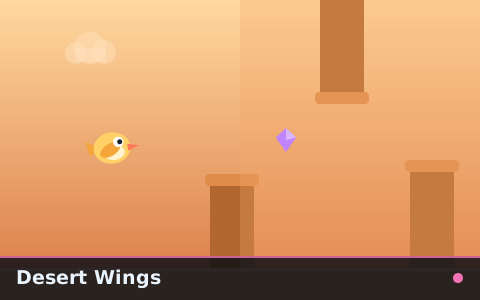
Sandstorm gusts push you sideways as well as up. Gems are buried in the worst of it.

Three stages of escalating gate patterns, then a shutter that closes on a rhythm you have to time, not react to.
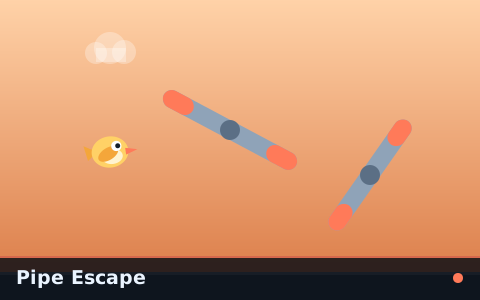
Rotating bars instead of pillars. The opening is always there — it just is not always where you are.

Weak gravity, heavy drag and a long, slow response to every stroke. The same game at a completely different tempo.
Cornerstone Guide
Why the same flap produces completely different results depending on when you make it, what lead time actually is, and how to fix the two timing errors that end most runs.
Technique
Why chasing a moving obstacle puts you permanently one beat behind, how to read a drift cycle, and the difference between predicting and reacting.
Design
What each approach is good at, why expert difficulty almost requires authored patterns, and the hybrid that most good endless games actually use.
Browse the flappy adventure games, the full library of 30 games, or the newest additions. If you are not sure what to try next, the best flappy games to play online suggests an order.