On this page
The trade
| Approach | Strength | Weakness |
|---|---|---|
| Constrained random | Infinite variety; nothing to memorise | Hard to guarantee interesting shapes |
| Authored patterns | Learnable; deliberate difficulty | Finite; memorisation replaces reading |
| Hybrid | Variety plus learnable vocabulary | More design work per game |
The tension is between novelty and learnability. Pure randomness is always new and therefore never learnable beyond general reading skill. Pure authoring is learnable and therefore eventually solved.
Why expert difficulty needs patterns
This is the least obvious point and the most important one.
At high speed, a purely random field becomes a pure execution test. There is no time to evaluate a novel shape, so all a player can do is react to each gate individually — and execution speed is the component of reaction time that does not improve with practice. The result is a game with a hard skill ceiling that arrives quickly and then never moves.
Authored patterns move the work into the decision stage, which does improve. Neon Flight draws from five hand-built sequences; the first twenty runs are chaos and somewhere around the thirtieth the shapes start arriving as patterns rather than as gates. Players describe the game as having slowed down. It has not — their deliberation has collapsed.
Random fields at expert speed test the one thing practice cannot improve. Authored patterns test the one thing it can.
The hybrid
What most good endless games actually do is generate from authored pieces: the generator chooses which shape comes next and where to place it, rather than choosing each gap independently.
The player then learns a vocabulary — a zig-zag, a staircase, a mirrored pair — and reads sequences rather than events. The order is never the same twice, so memorisation of a sequence is impossible, but recognition of a shape is not only possible but is exactly the skill the game rewards.
This is also how our boss content works. Boss Gate's shutter is entirely authored and entirely fixed, because it is meant to be counted rather than read, and something you count has to be reliable.
Choosing for your game
- Easy to medium, generated: constrained random is fine and cheaper. There is time to read a novel shape.
- Hard, mixed: constrained random with occasional authored sequences to provide texture.
- Expert, authored: a vocabulary of shapes, placed by a generator. Anything else tests execution alone.
- Boss or set-piece, fixed: fully authored and identical every time, so it can be learned precisely.
The mistake is using the same approach at every difficulty. A random generator that works beautifully at medium speed becomes an execution test at expert speed without changing a single line of code.
How many patterns is enough?
If you go the authored route, the obvious question is how many shapes you need before the library stops feeling repetitive.
Fewer than most people expect. Neon Flight uses five, and because each can be placed at different heights and followed by any of the others, the number of distinct experiences is far larger than five. The repetition players notice is of the sequence rather than of the shapes, and a generator choosing the order removes that entirely.
The practical floor is around four: below that, the same shape recurs closely enough that players start counting. Above about eight, you stop getting recognition benefits because no single shape appears often enough to become familiar.
Key takeaways
- Random fields are endlessly varied but never learnable; authored ones are learnable but eventually solved.
- At expert speed a random field tests execution, which is the component of reaction time that does not improve.
- The hybrid — a generator placing authored shapes — gives variety plus a learnable vocabulary.
- Boss content should be fully fixed, because something meant to be counted has to be reliable.
Frequently asked questions
Are your games random or authored?
Does memorising patterns spoil a game?
Why do random fields get worse at high speed?

Alex Morgan
Browser Games Editor & Interactive Gaming Content Specialist
Alex Morgan is the editorial byline for everything published on Flappy Arcade — the design notes, the flight-model tuning and the strategy guides for all 30 games. More about our editorial byline.
Published · Last updated
Games mentioned in this guide
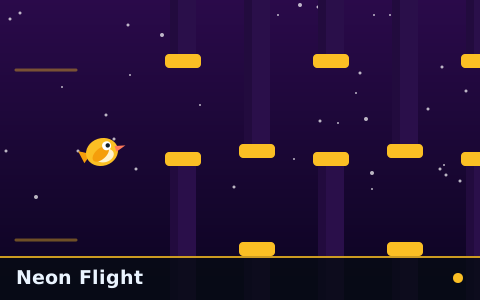
Neon Flight
Fast from the first gate, with obstacles packed into sequences that leave almost no recovery room.
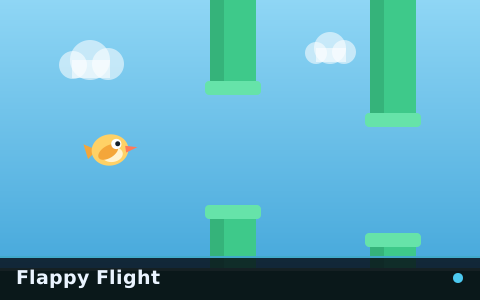
Flappy Flight
The reference flappy game: one flyer, one gap type, a speed that keeps climbing and nothing else in the way.

Boss Gate
Three stages of escalating gate patterns, then a shutter that closes on a rhythm you have to time, not react to.
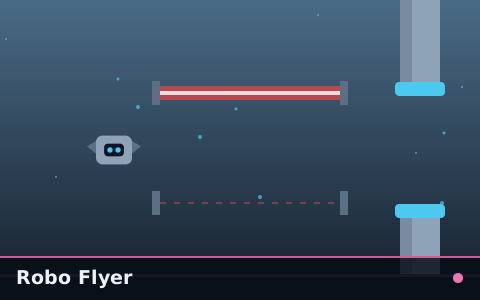
Robo Flyer
Energy beams that switch on and off on fixed cycles. The safe route is a moment rather than a place.