Reflex
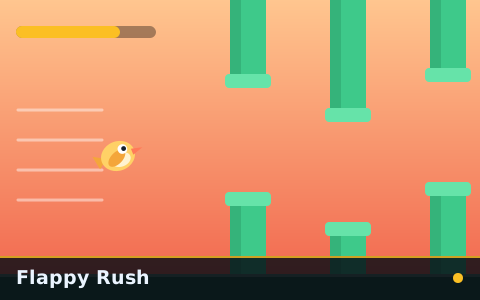
Flappy Rush
Starts readable and ends somewhere your rhythm cannot follow. A pure speed ramp with a visible speed meter.
Sky Reflex is built around a single idea: a gate that changes its mind. Any gate can flash once as it approaches and then jump to a new height. The flash is always there, it always comes first, and the window between the warning and the movement is about a third of a second.
Clear as many gates as you can in a field where gates shift height mid-approach. Each gate scores, and the combo multiplier rewards consecutive clean passes.
| Action | Keyboard / mouse | Touch |
|---|---|---|
| Flap | Space, W or Arrow Up | Tap anywhere on the play area |
| Pause / resume | P or Esc | Pause button in the game bar |
| Restart | R | Restart button in the game bar |
Pause with P or Esc, restart with R. The game pauses automatically if you switch tabs. More detail in keyboard controls for browser games and touch controls for arcade games.
What the game measures is not raw reaction speed but the cost of abandoning a plan. You have already chosen a line, you are already flying it, and now it is wrong. The players who handle that well are not the ones with the fastest hands — they are the ones who commit less hard in the first place, staying near the centre of the screen until the last moment so that a change costs them a small correction rather than a full reversal.
The shift itself is bounded. A gate never jumps further than 110 units, never jumps within 160 units of the screen edge, and never jumps twice. Those constraints make the mechanic a reaction test rather than a trick — if you see the flash and you are somewhere near the middle, the new position is always reachable.
Roughly one gate in three shifts at the start, rising to about two in three by the end of a long run. The rising frequency is what makes late runs exhausting: you stop being able to treat a shift as an exception and have to fly every gate as though it might move, which is a genuinely different and more tiring way to play.
The flash is white and lasts 0.28 seconds, and it is accompanied by a distinct sound. That is deliberate redundancy — the warning is never conveyed by colour alone, so it still works with the sound off and for players who would not reliably catch a colour change in peripheral vision.
Sky Reflex uses the site's shared flight model: gravity acts continuously on your vertical velocity, a flap sets that velocity rather than adding to it, and hard caps on rise and fall speed mean no situation is ever unrecoverable. The mechanics this game leans on are Flapping, Gravity, Moving Obstacles and timing.
If you want the numbers behind that, how flappy-style games work sets out the whole model, and how flapping mechanics work explains why a flap that sets velocity behaves so differently from one that adds to it.
Chosen by shared category, mechanics and difficulty — not at random.
Starts readable and ends somewhere your rhythm cannot follow. A pure speed ramp with a visible speed meter.
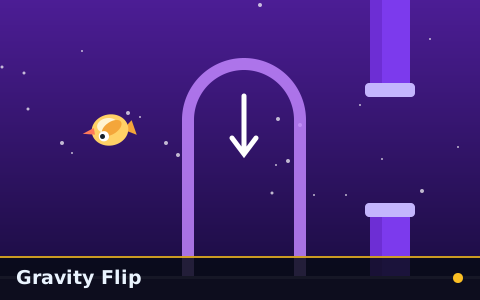
Fly through a flip gate and down becomes up. Your controls do not change — everything else does.
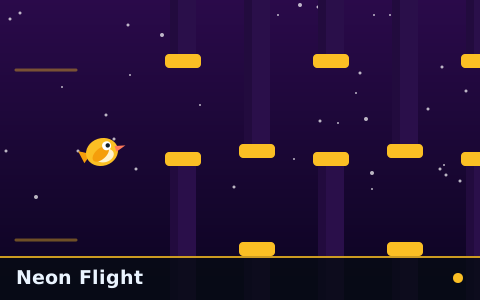
Fast from the first gate, with obstacles packed into sequences that leave almost no recovery room.
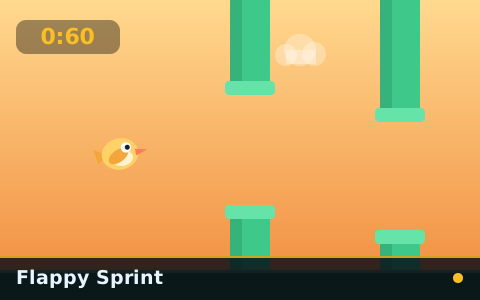
Sixty seconds, no more. Every attempt costs exactly one minute, which makes trying again almost free.
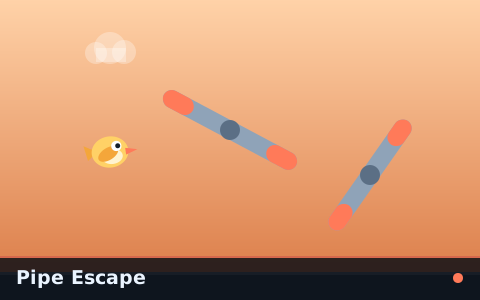
Rotating bars instead of pillars. The opening is always there — it just is not always where you are.
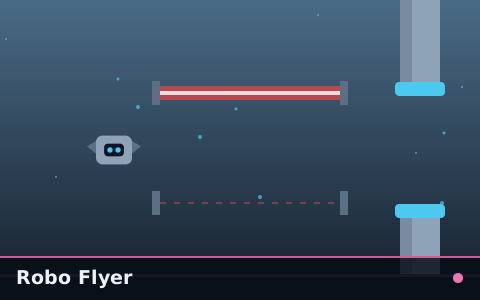
Energy beams that switch on and off on fixed cycles. The safe route is a moment rather than a place.
Cornerstone Guide
What can and cannot be trained, why recognition beats raw speed, where to look, and a practice routine that produces measurable improvement in a few sessions.
Cornerstone Guide
What a reflex game actually measures, the three components of reaction time and which of them practice improves, and how to get better at fast flappy games.
Technique
Why chasing a moving obstacle puts you permanently one beat behind, how to read a drift cycle, and the difference between predicting and reacting.
Browse the flappy reflex games, the full library of 30 games, or the newest additions. If you are not sure what to try next, the best flappy games to play online suggests an order.