
Obstacle
Boss Gate
Three stages of escalating gate patterns, then a shutter that closes on a rhythm you have to time, not react to.
Pipe Escape replaces pillars with rotating bars — original ones, not borrowed pipes. Each bar spins about a fixed hub, so the space you can fly through sweeps around continuously. The gap always exists. The question is whether you arrive when it is in front of you.
Get past as many rotating bars as you can. Each bar cleared scores, and the combo multiplier rewards consecutive passes without a crash.
| Action | Keyboard / mouse | Touch |
|---|---|---|
| Flap | Space, W or Arrow Up | Tap anywhere on the play area |
| Pause / resume | P or Esc | Pause button in the game bar |
| Restart | R | Restart button in the game bar |
Pause with P or Esc, restart with R. The game pauses automatically if you switch tabs. More detail in keyboard controls for browser games and touch controls for arcade games.
A rotating bar is a genuinely different problem from a gate. A gate asks where; a rotor asks when. Because the bar sweeps through every angle, there is no permanently safe height — there is only a safe moment, and the moment repeats on a period you can measure by watching.
Bars alternate spin direction and vary in length and speed, and each one sits at a height chosen so that the sweep never quite reaches the ceiling or the floor. That leaves a permanent escape lane above or below every rotor, which is the mechanic's safety valve: if you misjudge the phase entirely, there is a route that does not require timing at all, and it is usually the right choice under pressure.
The fast route is to pass through the sweep while the bar is vertical, using the horizontal space either side of it. The safe route is to go over or under. Good runs use both, and knowing which you are attempting before you commit is most of the game — the deaths almost always come from starting one and switching to the other halfway.
Collision on a rotor is sampled along the bar rather than treated as a rectangle, so a fast spin never tunnels past your flyer and a near miss at the tip is genuinely a near miss. That makes the hitbox match what you see, which matters a great deal when the thing you are avoiding is moving in two dimensions at once.
Pipe Escape uses the site's shared flight model: gravity acts continuously on your vertical velocity, a flap sets that velocity rather than adding to it, and hard caps on rise and fall speed mean no situation is ever unrecoverable. The mechanics this game leans on are Flapping, Gravity, Moving Obstacles and timing.
If you want the numbers behind that, how flappy-style games work sets out the whole model, and how flapping mechanics work explains why a flap that sets velocity behaves so differently from one that adds to it.
Chosen by shared category, mechanics and difficulty — not at random.
Three stages of escalating gate patterns, then a shutter that closes on a rhythm you have to time, not react to.
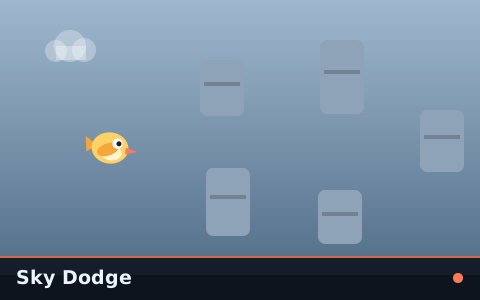
No gates at all. Free-floating barriers drift up and down, and you have to aim at where they will be.
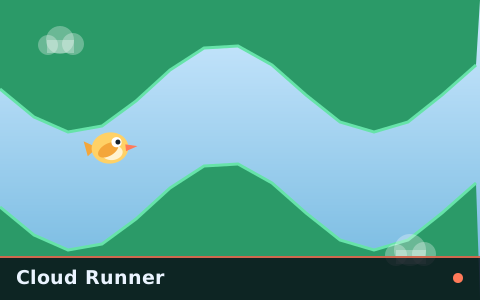
A continuous cloud corridor with no discrete gates. The walls never stop moving and neither can you.

Cloud Runner's corridor, tighter and faster, in a tunnel that keeps closing in. Relentless, but never hidden and never unflyable.

Gates that move once, mid-approach, after flashing a warning. A pure test of how fast you can change a plan.
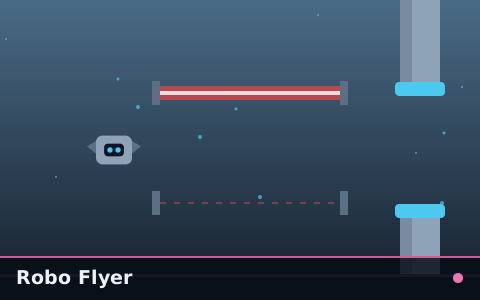
Energy beams that switch on and off on fixed cycles. The safe route is a moment rather than a place.
Cornerstone Guide
What avoidance actually asks of a player, the four obstacle families and the different skills they test, and why reading two obstacles ahead changes everything.
Technique
Why chasing a moving obstacle puts you permanently one beat behind, how to read a drift cycle, and the difference between predicting and reacting.
Cornerstone Guide
Why the same flap produces completely different results depending on when you make it, what lead time actually is, and how to fix the two timing errors that end most runs.
Browse the flappy obstacle games, the full library of 30 games, or the newest additions. If you are not sure what to try next, the best flappy games to play online suggests an order.