
What a reflex game actually measures
Reaction time is often described as a single number, as though it were a fixed property of a person. In an arcade game it is really three separate things stacked together: how long it takes you to notice a change, how long it takes you to decide what to do, and how long it takes your hand to do it.
The third of those barely varies and cannot be trained much. The first can be improved a great deal by looking in the right place. The second improves enormously with familiarity, because a decision you have made a thousand times stops being a decision at all.
This matters because it tells you what practice is for. You are not making your nerves faster. You are removing the deliberation step, so that a gap appearing high produces a flap without an intervening thought. That is why reflex scores improve in steps rather than smoothly — a pattern stops being processed and starts being recognised.
How our reflex games shorten the window
There are three honest ways to make a flying game demand faster reactions, and one dishonest one. The honest ones: raise the scroll speed so obstacles arrive sooner; reduce the spacing so decisions come closer together; or change something after the player has seen it but before they have reached it.
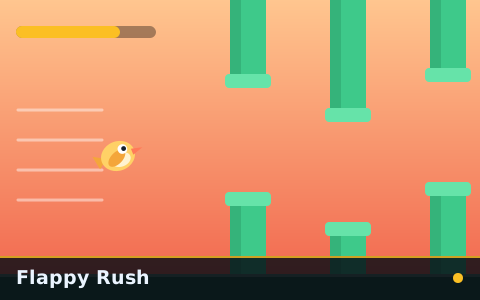
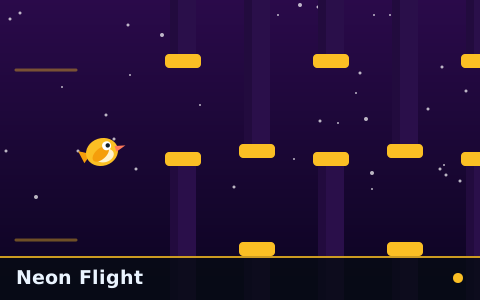
Flappy Rush uses the first, ramping speed steadily until the whole field is arriving faster than it can comfortably be read. Neon Flight uses the second, keeping the speed high and packing gates into sequences with almost no recovery room. Sky Reflex uses the third: a gate can shift vertically once, and it always telegraphs the shift with a flash before it happens.
The dishonest way is to spawn something with no warning at all. We never do it. Every change in every reflex game here is visible before it matters — the window is short, but it exists. A game that kills you with information you could not have had is not testing your reflexes; it is testing your luck.
Warming up is not a myth
Reaction time genuinely is worse in the first thirty seconds of play than it is two minutes in. If you have ever noticed that your first run of a session is consistently poor and your third or fourth is your best, that is not superstition.
The practical consequence is that your first attempt at a reflex game should be treated as a warm-up rather than an attempt. Play one deliberate run where you are not trying to score — just moving and reading — and then start counting. Most players find their average improves immediately, without anything else changing.
The other half of this is knowing when to stop. Reaction time degrades measurably with fatigue, and the run where you are certain you are about to beat your best is very often the run where you are already several tenths slower than you were. If three runs in a row end earlier than your recent average, the session is over.
Reflex games and accessibility
A game built around speed is, by definition, hard to make accessible to everyone, and we would rather say that plainly than pretend otherwise. Reflex games are the least accessible category on this site for players with motor or visual impairments.
What we do about it: every game pauses instantly with P or Esc and when the tab loses focus; nothing depends on colour alone; no obstacle is ever announced only by a flash; and every reflex game has a slower counterpart elsewhere on the site that tests the same skill without the time pressure. If speed is the barrier, the precision category asks for the same accuracy with far more time to produce it.
Quick tips for flappy reflex games
- Play one throwaway warm-up run before you start counting. Cold reaction time is measurably worse.
- Watch the point where obstacles enter the screen, not the point where they reach you.
- When a game telegraphs a change with a flash, react to the flash — not to the movement that follows it.
- Stop when three runs in a row end early. Fatigue costs more than practice gains at that point.
- Lower speed does not mean easier; a fast field you can read is easier than a slow one you cannot.