
What makes a flappy game endless
An endless game is not simply a game without an ending. It is a game whose content is generated rather than authored, which changes what you are actually learning when you play it. In a level-based game you learn a sequence. In an endless game there is no sequence to learn, so what improves instead is your reading — how early you identify where the next opening is, and how smoothly you get to it.
Every endless game on this site generates its obstacles the same way: a gap height that shrinks toward a floor, a gap position chosen relative to the previous one rather than at random, and a scroll speed that rises toward a ceiling. The second of those three is the important one. Placing each gap within a limited vertical distance of the last means the field can never demand a climb the flight model cannot deliver in the time available.
The result is that an endless run is always survivable in principle. When you die, the pattern in front of you was passable — which is a more useful thing to know than it sounds, because it moves the question from "was that fair?" to "what would I have done differently?"
How difficulty climbs, and why it stops
The obvious way to build an endless game is to make it harder forever. We do not do that, and the reason is worth explaining. If difficulty rises without limit, then every run ends the same way — at the point where the game becomes physically impossible — and the score simply measures how long it took to reach that wall. Skill stops being the variable.
Instead, each of these games approaches a ceiling. Gaps shrink toward a minimum that is always comfortably larger than the flyer plus a correction; speed rises toward a maximum that a practised player can hold indefinitely. Past roughly ninety seconds the game stops getting harder and simply stays hard. A run then ends when concentration slips, not when a threshold is crossed.
That design decision is why endless scores tend to plateau and then jump. Players grind out small improvements, then find a rhythm that works at the ceiling and add a large chunk in one session.
The habit that costs endless players the most
Watching the flyer instead of the gap. It is the single most common mistake in the genre and it is almost universal among new players: your eyes lock onto the character, because that is the thing you control, and you correct based on where it is right now.
The problem is that a flap takes effect over roughly a third of a second. By the time a correction based on the current position has played out, the situation has moved on. Players who improve fastest are the ones who move their attention to a point roughly two-thirds of the way to the next gap and let peripheral vision handle the flyer itself.
There is a simple way to test whether you already do this: play thirty seconds and then try to describe what colour the flyer's wing was. If you cannot, you are watching the gap, and your scores probably already show it.
The second-most expensive habit is over-flapping after a near miss. A scare produces an adrenaline flap, the flyer shoots upward, and the next gap is missed from above — a mistake caused entirely by the previous obstacle rather than the current one.
Which endless game to start with
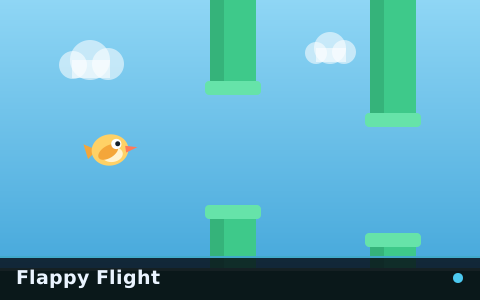
Flappy Flight is the reference implementation and the right first game for almost everyone: one flyer, one gap type, a speed ramp and nothing else. Everything else on the site is a variation on the habits it teaches.
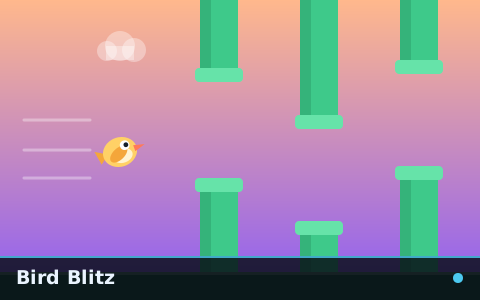
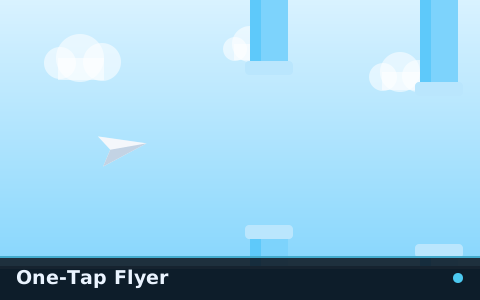
If the classic rhythm feels too fast, One-Tap Flyer uses a gentler flight model and wider spacing, which gives you more time to see a decision coming. If it feels too slow, Bird Blitz starts where Flappy Flight finishes.
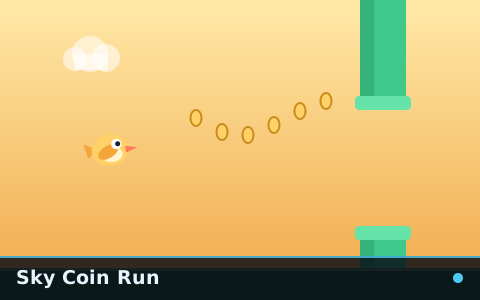
Endless Wings strips out scoring entirely in favour of distance, which changes how the run feels: there is nothing to chase but the next metre. And Sky Coin Run adds a second, optional scoring line through every gap, so the safe route and the greedy route stop being the same route.
Quick tips for flappy endless games
- Look at the gap you are flying toward, not at your flyer. Peripheral vision handles the flyer perfectly well.
- Small, frequent flaps beat large, occasional ones — every big flap costs you a long uncontrolled fall afterwards.
- After a near miss, deliberately skip one flap. The panic flap after a scare causes more deaths than the scare did.
- Aim for the centre of a gap, not the edge you can see best. Centre lines leave room for a mistake in both directions.
- When speed increases, do not flap faster — flap earlier. The rhythm stays the same; the lead time changes.