

Environment as a mechanic, not a backdrop
The easy version of a themed game is to recolour the background and call it an adventure. That is not what these are. In each of them the environment changes the flight model itself, and the art exists to tell you what the change is before you feel it.
Underwater Flap is the clearest example. Under water, gravity is much weaker, drag is much stronger, and a flap produces a slower, longer glide. The result is a game that looks like the others and controls nothing like them: you plan much further ahead because corrections take much longer to take effect.
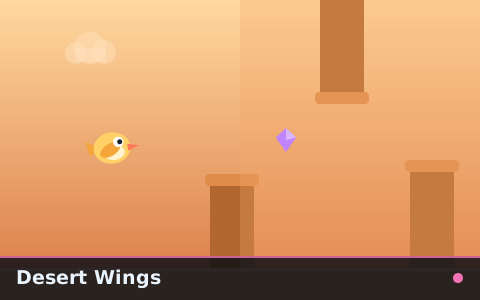
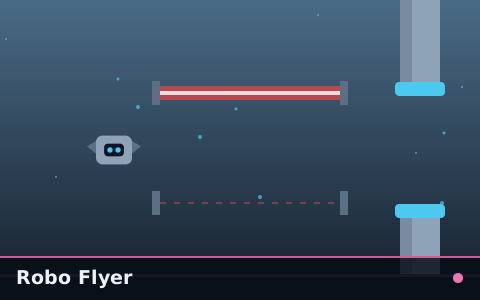
Desert Wings adds sandstorm gusts that push the flyer rather than merely obscuring the view. Robo Flyer keeps the physics standard and makes the hazards timed instead of positional, which is a different kind of pressure again. Jungle Flyer also keeps the physics familiar and changes the obstacles instead, hanging them from the canopy in irregular lengths.
Stages, and what progression is actually for
Every game here is divided into stages that arrive on a schedule you can feel. A stage change is announced visually — the sky shifts, the music of the sound effects changes pitch, the obstacle family rotates — and it always makes the run measurably different rather than merely faster.
Progression serves two purposes in an arcade game. The first is pacing: a run that changes every forty seconds holds attention far longer than one that does not. The second is diagnosis. When every run ends in stage two, you know precisely which mechanic is beating you, which is much more actionable than a score that is simply lower than you wanted.
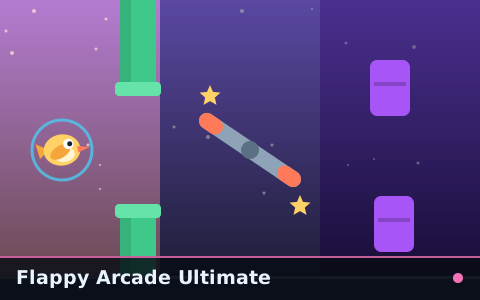
Flappy Arcade Ultimate is the fullest version of this. It moves through three environments with their own obstacle sets, adds power-ups from the second stage onward, and finishes with a gate sequence that has to be timed rather than reacted to. It is the flagship and the game we would point at if someone asked what the site is for.
Collectibles that change your line
Adventure games are where collectibles do the most work. A star sitting in the middle of a gap is decoration; a star sitting slightly above the safe line is a decision. All of the collectible placement in this category is built on that second idea.
Patterns are deliberately shaped so that taking everything requires a line that is a little worse than the safest one: arcs that pull you high on the approach, columns that ask you to arrive at a gap from an awkward height, stair patterns that are easy going up and awkward coming down.
Collectibles in every game on this site are decorative score items. They are not currency, cannot be purchased, and cannot be exchanged for anything. There are no in-app purchases anywhere on Flappy Arcade.
Where to start in this category
Jungle Flyer is the gentlest entry point because its physics are the standard ones — only the obstacles are unusual. From there, Robo Flyer introduces timed hazards, which is the skill the flagship's final sequence depends on.
Underwater Flap and Desert Wings are the two that will feel wrong at first, and both are worth pushing through: they are the clearest demonstration on the site of how much of your skill is tied to one specific flight model rather than to flying in general. Ice Flyer, over in the precision category, makes the same point from the opposite direction.
Finish with Flappy Arcade Ultimate. It assumes the habits every other game teaches and is genuinely hard without them.
Quick tips for flappy adventure games
- Learn each environment's flight model before chasing score — a stage change is a physics change, not a reskin.
- Under water and on ice, plan two obstacles ahead: corrections take far longer to take effect.
- Take a collectible only when the line it asks for is one you would fly anyway.
- Use stage transitions as breathing room. They are deliberately the least dense moments of a run.
- In the flagship, save a shield for the final gate sequence rather than spending it on an early mistake.