

Why an objective changes how a run feels
An endless game's only question is "how long?". That is a good question, but it has one structural weakness: a run that ends badly feels like a wasted run, because there is nothing to show for it but a number lower than your last number.
A challenge game gives a run a shape. A sixty-second timer means every attempt costs exactly one minute, which makes the decision to try again almost free. A feather quota means a run where you flew badly but collected well still produced something. A combo chain gives you a reason to care about the gate you are on rather than the one thirty gates from now.
The design consequence is that challenge games tolerate a much higher failure rate than endless games do. Ultimate Flappy Challenge is the hardest game on the site by some distance, and it is also the one people replay most immediately after failing — because the failure was specific. You know exactly which objective you missed.
The five kinds of objective we use
| Objective | How it works | Game |
|---|---|---|
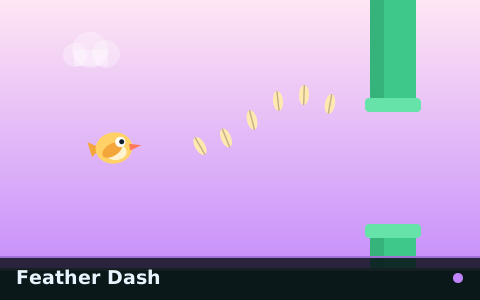
| Collection quota | Gather a target number of items while surviving | Feather Dash |
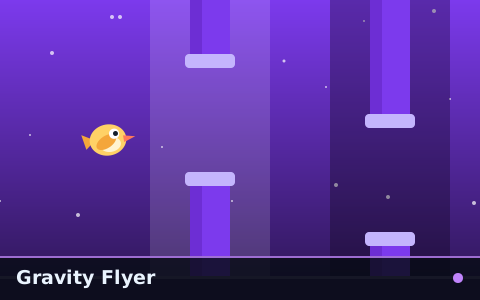
| Environmental shift | Handle a mechanic that changes mid-run | Gravity Flyer |
| Inverted control | Unlearn the flap before you can use it | Balloon Escape |
| Sustained control | Hold a continuous input rather than tapping | Rocket Flap |
| Mixed mission | Several objectives layered in one run | Ultimate Flappy Challenge |
Time attack is the one objective that does not live in this category: Flappy Sprint sits with the reflex games, because a sixty-second clock turns out to test speed far more than it tests planning.
The one that surprises people is sustained control. Every other game in the genre is built around discrete taps; Rocket Flap gives you a thruster you hold, which turns altitude into a continuous variable rather than a series of impulses. Players who are good at the rest of the site are frequently bad at it for the first few minutes, because the muscle memory actively works against them.
Combos: what they reward and what breaks them
Three of these games use a combo multiplier. The rule is consistent across the site: consecutive successes raise the multiplier, and it resets on a mistake or after a gap in activity. It is a consistency reward, not a speed reward.
That distinction matters more than it sounds. A player who clears twenty gates cleanly outscores a player who clears thirty with two collisions in the middle, because the second player spent most of their run at a multiplier of one. The effect is that cautious flying is usually the higher-scoring strategy, which is not what most players assume when they start.
The other consequence is that a combo is worth protecting. If a collectible sits on a line that risks the gate, the collectible is almost never worth it — an eight-point orb does not pay for losing a ×3 multiplier that was about to apply to the next dozen gates.
Practice mode, and using it properly
Ultimate Flappy Challenge and Balloon Escape both include a practice option that removes the scoring pressure while leaving the mechanics intact. It exists because the fastest way to learn an unfamiliar control scheme is to use it without anything riding on it.
The way to get value out of it is to practise one thing at a time. Fly a practice run where the only goal is holding a constant altitude. Then one where the only goal is arriving level at every gate. Then one where you take every collectible regardless of risk, to find out where the greedy line actually is. Three focused practice runs will teach you more than twenty scored attempts.
Quick tips for flappy challenge games
- Protect the combo. A multiplier applied to the next twenty gates is worth far more than any single pickup.
- In a time attack, the clock is the only resource — a cautious run that survives the full minute usually outscores a fast one that ends early.
- Use practice mode to rehearse one specific thing, not to play the game with the stakes removed.
- Read the objective before you start. Several of these games are lost by playing them as endless runs.
- When a run is already failing an objective, finish it deliberately rather than restarting — you learn more from the last twenty seconds than the first.