On this page
The case against rising forever
The obvious way to build an endless game is to make it harder without limit until the player dies. Almost every first attempt at the genre does this, and it produces a specific, recognisable problem.
If difficulty rises forever, then every run ends at the point where the game becomes physically impossible. The score therefore measures how long it took you to reach that wall, and since the wall is in the same place every time, the variance between runs collapses. Good players and mediocre players end up with scores far closer together than their skill difference warrants, because the game is doing most of the work of ending the run.
It also removes the most satisfying experience the genre can offer, which is holding a state that used to be beyond you. If the game keeps accelerating, there is no state to hold.
The asymptotic curve
The alternative is a curve that rises quickly and then flattens toward a limit. We use an exponential approach, which in practice means: about half of the total change has happened by twenty seconds, about 85% by sixty, and the remainder never quite arrives.
| Time | Progress toward ceiling | What it feels like |
|---|---|---|
| 0–10 s | ~25% | Warm-up; a new player can find the rhythm |
| 10–30 s | ~55% | The game starts pushing back |
| 30–60 s | ~85% | Recognisably hard |
| 60–90 s | ~95% | Near maximum |
| 90 s+ | ~100% | Steady state — it does not get harder |
The steady state is the design goal, not a limitation. Past ninety seconds the game is as hard as it will ever be, and a run then ends because concentration slipped rather than because a threshold was crossed. That is a much better failure: it is attributable, it is improvable, and it is the reason endless scores plateau and then jump rather than creeping.
One exception on this site: Flappy Rush uses a linear ramp for its first ninety seconds before flattening. That is deliberate — it is a reflex game specifically about continuous escalation, and it is filed under reflex rather than endless for exactly that reason.
The four levers
There are only four things a flappy game can make harder, and they are not interchangeable.
- Gap size. Shrinking the opening raises the accuracy demand. It has a hard floor derived from the flight model and it does not interact well with speed.
- Scroll speed. Raising it shortens the time available for every decision. This is the lever that most changes how a game feels.
- Spacing. Reducing the distance between obstacles raises the rate of decisions without changing any individual one.
- Obstacle complexity. Adding movement, timing or layering changes what kind of decision is being made rather than how hard it is.
The mistake most often made is pulling all four at once. A game that simultaneously narrows gaps, speeds up, tightens spacing and adds moving obstacles becomes hard for four reasons simultaneously, and the player cannot tell which one beat them — which means they cannot improve at it.
Every game on this site pulls one lever hard and leaves the others mostly alone. Flappy Rush raises speed and keeps gaps generous. Gap Hunter shrinks gaps and keeps speed low. Neon Flight tightens spacing. That separation is what makes each of them teachable.
The compounding problem nobody plans for
Here is the subtlety that catches out most first-time designers of this genre.
Spacing is usually specified as a distance — obstacles are 300 units apart. Scroll speed is a rate — 180 units per second. What the player actually experiences is neither: it is the time between decisions, which is spacing divided by speed.
| Stage | Spacing | Speed | Time between decisions |
|---|---|---|---|
| Start | 300 | 172 | 1.74 s |
| Mid-run | 255 | 240 | 1.06 s |
| Ceiling | 210 | 300 | 0.70 s |
Spacing falls by 30% and speed rises by 74%, but the time between decisions falls by 60%. Neither curve looks alarming on its own; together they produce a much steeper difficulty ramp than either was designed to deliver.
The practical rule is to tune against the derived quantity rather than the inputs. We check decision interval directly and adjust spacing upward when speed rises — which is why Sky Dodge actually widens its spacing as its obstacles start moving more.
Difficulty selectors versus difficulty curves
A selector and a curve do different jobs and the difference is worth keeping clear.
A curve is what happens within a run: the game gets harder as you survive. A selector is a choice made before the run about where that curve starts and how steeply it climbs.
Flappy Arcade Ultimate is the only game here with a selector, and it changes real numbers rather than labels: gap size, scroll speed, spacing and ramp rate all scale together. Easy is a genuinely different game rather than a slower one.
| Setting | Gap | Speed | Spacing | Ramp |
|---|---|---|---|---|
| Easy | ×1.22 | ×0.84 | ×1.18 | ×1.7 slower |
| Medium | ×1.00 | ×1.00 | ×1.00 | baseline |
| Hard | ×0.86 | ×1.14 | ×0.90 | ×0.75 faster |
| Expert | ×0.76 | ×1.28 | ×0.82 | ×0.55 faster |
We deliberately do not put a selector on every game. A published tuning figure is only meaningful if it describes what you actually played, and a hidden global difficulty setting would make every number in these guides approximate.
The first thirty seconds are a promise
Every game on this site is deliberately gentle for its first stretch, and that is a design rule rather than an accident.
A first-time player needs to survive long enough to learn what the control does before the game starts pushing back. If a brand-new player dies in three seconds on their first five attempts, a significant proportion of them conclude the game is broken rather than that they are new — and they are not wrong to, because they have received no information.
The opening is therefore an implicit promise: the game will let you understand it. Bird Blitz and Neon Flight are the two games here that start hard, and both compensate — Bird Blitz with two seconds of empty sky, Neon Flight with a placement in the expert tier and a recommendation to warm up elsewhere first.
Key takeaways
- Difficulty that rises forever makes every run end at the same wall and collapses the difference between players.
- An asymptotic curve reaches roughly 85% of its ceiling by sixty seconds and then holds, so runs end on concentration.
- There are four levers — gap, speed, spacing, complexity — and pulling all four at once makes a game unteachable.
- Tune against the time between decisions, not against spacing and speed separately; they compound.
- The first thirty seconds are a promise that the game will let a new player understand it.
Frequently asked questions
Why should difficulty stop rising?
Why does a game feel much harder than its numbers suggest?
Do all your games have a difficulty selector?
Why are the first thirty seconds so easy?

Alex Morgan
Browser Games Editor & Interactive Gaming Content Specialist
Alex Morgan is the editorial byline for everything published on Flappy Arcade — the design notes, the flight-model tuning and the strategy guides for all 30 games. More about our editorial byline.
Published · Last updated
Games mentioned in this guide
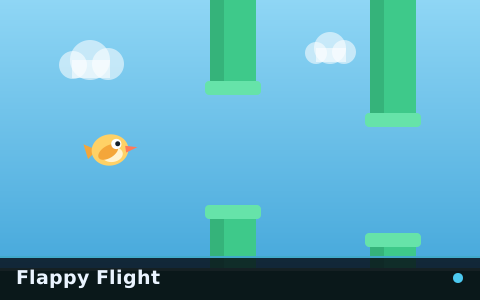
Flappy Flight
The reference flappy game: one flyer, one gap type, a speed that keeps climbing and nothing else in the way.
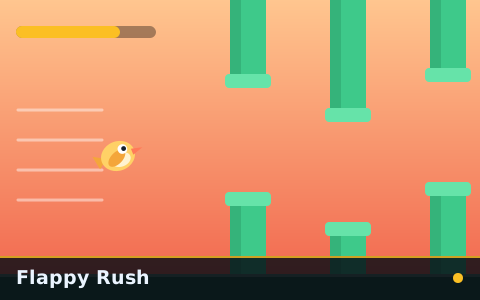
Flappy Rush
Starts readable and ends somewhere your rhythm cannot follow. A pure speed ramp with a visible speed meter.
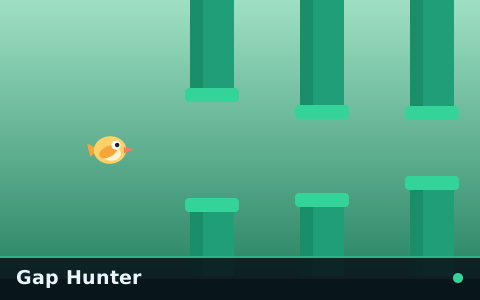
Gap Hunter
The openings shrink with every gate you pass. They stop shrinking at a width that is genuinely passable — eventually.
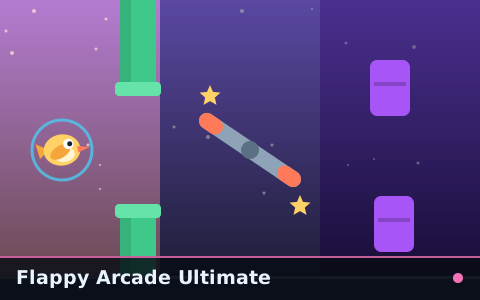
Flappy Arcade Ultimate
Three skies, three obstacle sets, power-ups, collectibles, a difficulty selector and a boss gate at the end of it.