
Challenge
Ultimate Flappy Challenge
Four stages, each with its own objective, layered on top of each other. The hardest game here, and the most specific about why you failed.
Feather Dash gives you a quota. Collect eight feathers to clear the first stage, twelve for the second, sixteen for the third, and so on for as long as you can keep up. The feathers are never quite on the safest line, which is the entire game.
Collect enough feathers to clear each stage before the field outpaces you. Feathers collected is the recorded result, and the combo multiplier counts toward the quota as well as the score.
| Action | Keyboard / mouse | Touch |
|---|---|---|
| Flap | Space, W or Arrow Up | Tap anywhere on the play area |
| Pause / resume | P or Esc | Pause button in the game bar |
| Restart | R | Restart button in the game bar |
Pause with P or Esc, restart with R. The game pauses automatically if you switch tabs. More detail in keyboard controls for browser games and touch controls for arcade games.
The quota structure changes what a run is for. In an endless collector, gathering is optional — you can ignore every pickup and still post a long run. Here, ignoring them ends the stage, because a stage only advances when the quota is met and the field gets harder on a timer regardless. You cannot play it safe and you cannot play it greedy; you have to do both alternately.
Feathers are placed in seven pattern types, each generated relative to the nearest gate: arcs that lift you on the approach, columns that sit above or below the opening, zig-zags between gates, stair patterns that lead diagonally, clusters just past a gate, waves that ride alongside the scroll, and straight lines through the middle. The last of those is the only one that is free; the other six all ask for something.
Collecting feathers consecutively without missing one builds the combo multiplier, and the multiplier applies to the stage quota as well as to score — a feather taken at ×3 counts as three toward the quota. That is the mechanic that makes greedy play viable: a clean chain through a cluster can clear half a stage on its own.
Missing a feather does not break the chain, but crashing does. Since crashing also ends the run, the practical rule is simple: never take a feather that risks the gate. The combo you keep is worth more than the feather you take.
Feather Dash uses the site's shared flight model: gravity acts continuously on your vertical velocity, a flap sets that velocity rather than adding to it, and hard caps on rise and fall speed mean no situation is ever unrecoverable. The mechanics this game leans on are Flapping, Gravity, Collectibles and combo.
If you want the numbers behind that, how flappy-style games work sets out the whole model, and how flapping mechanics work explains why a flap that sets velocity behaves so differently from one that adds to it.
Chosen by shared category, mechanics and difficulty — not at random.
Four stages, each with its own objective, layered on top of each other. The hardest game here, and the most specific about why you failed.

The balloon rises on its own. Your button vents it downward — every instinct you have is now wrong.
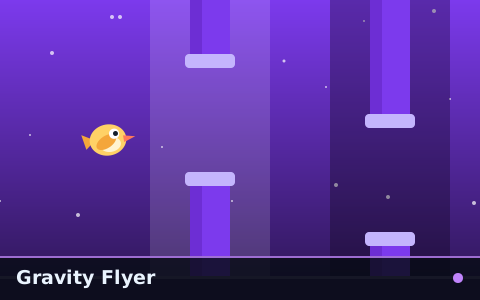
Coloured zones change how heavy you are. Same button, same gates, three completely different flight models.

A thruster you hold instead of a flap you tap. Altitude becomes continuous, and fuel makes it finite.
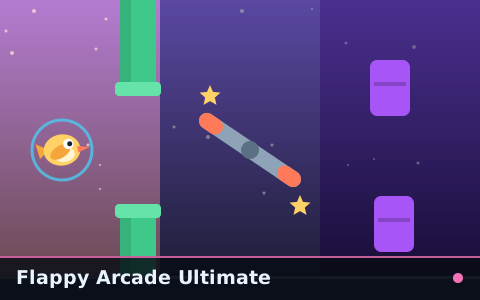
Three skies, three obstacle sets, power-ups, collectibles, a difficulty selector and a boss gate at the end of it.
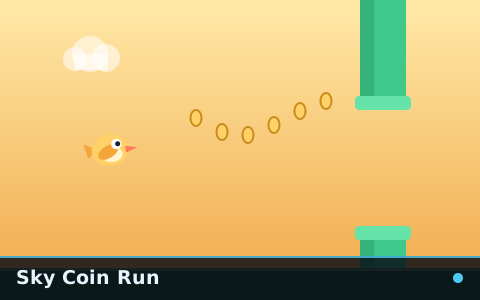
Every gate has two routes: the safe one and the one with the coins on it. They are rarely the same route.
Design
Why a collectible is only interesting when it is off the safe line, the seven placement patterns we use, and how to decide whether a pickup is worth the detour.
Cornerstone Guide
What a combo multiplier actually rewards, why consistency beats aggression mathematically, how chains break, and how to play around a multiplier instead of ignoring it.
Scoring
The arithmetic of a multiplier, how much a chain is really worth, when to stop taking risks, and why rebuilding after a break should be done cautiously.
Browse the flappy challenge games, the full library of 30 games, or the newest additions. If you are not sure what to try next, the best flappy games to play online suggests an order.