Challenge
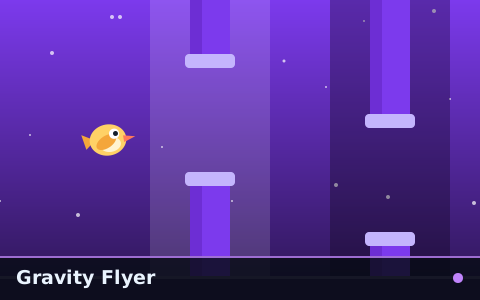
Gravity Flyer
Coloured zones change how heavy you are. Same button, same gates, three completely different flight models.
Rocket Flap replaces the tap with a hold. There is no flap impulse — there is a thruster, and it runs for exactly as long as you hold the button. Altitude stops being a series of jumps and becomes a continuous quantity you steer, which is a genuinely different skill.
Fly through gates using a fuel-limited thruster rather than a flap. Score is standard; managing the tank is the actual challenge.
| Action | Keyboard / mouse | Touch |
|---|---|---|
| Thrust | Hold Space, W or Arrow Up | Hold anywhere on the play area |
| Pause / resume | P or Esc | Pause button in the game bar |
| Restart | R | Restart button in the game bar |
Pause with P or Esc, restart with R. The game pauses automatically if you switch tabs. More detail in keyboard controls for browser games and touch controls for arcade games.
Everything in the genre is built around discrete impulses. A flap is an event: it happens, it is over, and you deal with the consequences. A thruster is a state, and states require a different kind of attention — you are not choosing moments, you are choosing durations, and a duration can be wrong by a small amount in a way a tap cannot.
Players who are good at the rest of the site are frequently bad at this for the first few minutes, and the reason is visible in their input pattern: they tap. Tapping a thruster produces a stutter of tiny impulses that is strictly worse than either holding or not holding. The adjustment is to think in half-seconds rather than in beats.
Fuel is what stops the thruster from trivialising the game. The gauge holds about 2.6 seconds of continuous burn and refills at roughly a third of that rate while you are gliding, which means sustained flight is impossible and every climb has to be paid for with a glide. Running the tank dry drops you hard, and the gauge flashes at 25% so the moment is never a surprise.
The obstacle field is deliberately conventional — standard metal gates at moderate spacing. When the control scheme is the novelty, making the obstacles novel as well would produce a game where you never find out which one is beating you.
Rocket Flap uses the site's shared flight model: gravity acts continuously on your vertical velocity, a flap sets that velocity rather than adding to it, and hard caps on rise and fall speed mean no situation is ever unrecoverable. The mechanics this game leans on are Thrust, Gravity, Fuel and altitude control.
If you want the numbers behind that, how flappy-style games work sets out the whole model, and how flapping mechanics work explains why a flap that sets velocity behaves so differently from one that adds to it.
Chosen by shared category, mechanics and difficulty — not at random.
Coloured zones change how heavy you are. Same button, same gates, three completely different flight models.
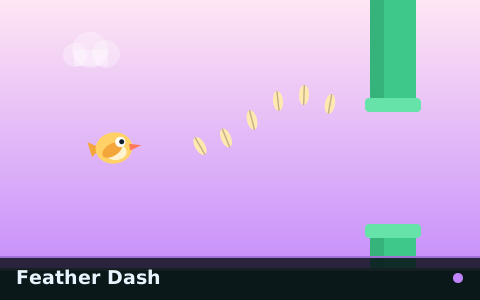
Feathers appear on lines that are slightly worse than the safe one. Hit the quota and the next quota is larger.

Four stages, each with its own objective, layered on top of each other. The hardest game here, and the most specific about why you failed.

The balloon rises on its own. Your button vents it downward — every instinct you have is now wrong.

Almost no drag. Momentum carries far past the flap that caused it, and every correction arrives late.
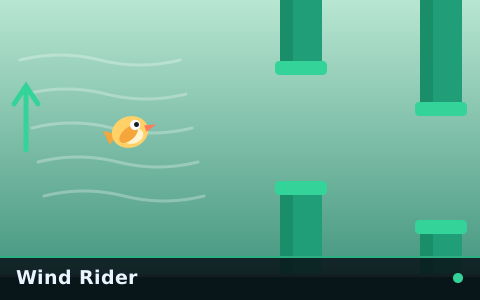
A vertical wind field that changes every few seconds. The rhythm that held your height a moment ago no longer does.
Controls
What happens between a key press and a flap: edge detection, cooldowns, input unification across devices, and why one press must always mean exactly one flap.
Cornerstone Guide
What actually happens when you flap: impulse versus accumulation, cooldowns, rotation lag, the feel of different flap forces, and why the wing animation matters.
Cornerstone Guide
The order to tune the numbers in, the four targets we test every game against, the mistakes that make a flappy game feel wrong, and how a game gets from idea to published.
Browse the flappy challenge games, the full library of 30 games, or the newest additions. If you are not sure what to try next, the best flappy games to play online suggests an order.