
Challenge
Balloon Escape
The balloon rises on its own. Your button vents it downward — every instinct you have is now wrong.
Gravity Flyer divides the sky into zones. A pale zone halves your weight, a dark zone doubles it, and a normal zone leaves you alone. You can see the boundaries coming from a long way off, which is the only reason the game is survivable.
Keep flying through gates while gravity changes around you. Scoring is standard; the difficulty is entirely in re-learning the rhythm three times a minute.
| Action | Keyboard / mouse | Touch |
|---|---|---|
| Flap | Space, W or Arrow Up | Tap anywhere on the play area |
| Pause / resume | P or Esc | Pause button in the game bar |
| Restart | R | Restart button in the game bar |
Pause with P or Esc, restart with R. The game pauses automatically if you switch tabs. More detail in keyboard controls for browser games and touch controls for arcade games.
Gravity is the number that defines a flappy game. Change it and everything derived from it changes with it: how fast you fall, how far a flap carries you, how long a correction takes to take effect, and therefore how early every decision has to be made. Gravity Flyer makes that explicit by giving you three of them in the same run.
In low gravity the flyer floats. A flap carries much further, falls are slow, and the danger is the ceiling rather than the floor — new players consistently over-flap and pin themselves to the top of the screen. In high gravity the flyer drops like a stone, a single flap barely recovers you, and the rhythm has to roughly double. In normal gravity everything behaves like the rest of the site.
Zone boundaries are vertical bands of colour crossing the whole field, and the transition is instant rather than gradual. That is deliberate: a gradual transition would be impossible to prepare for, whereas a hard boundary you can see approaching lets you arrive at it in the right state. The correct play is almost always to be centred and level when you cross.
Zones last between six and eleven seconds and never chain two extremes together — a heavy zone is always followed by a normal one before another light one. That rule exists so the game asks you to adapt twice rather than to reverse instantly, which would have been a reflex test rather than an adaptation one.
Gravity Flyer uses the site's shared flight model: gravity acts continuously on your vertical velocity, a flap sets that velocity rather than adding to it, and hard caps on rise and fall speed mean no situation is ever unrecoverable. The mechanics this game leans on are Flapping, Gravity, Timing and obstacle avoidance.
If you want the numbers behind that, how flappy-style games work sets out the whole model, and how flapping mechanics work explains why a flap that sets velocity behaves so differently from one that adds to it.
Chosen by shared category, mechanics and difficulty — not at random.
The balloon rises on its own. Your button vents it downward — every instinct you have is now wrong.
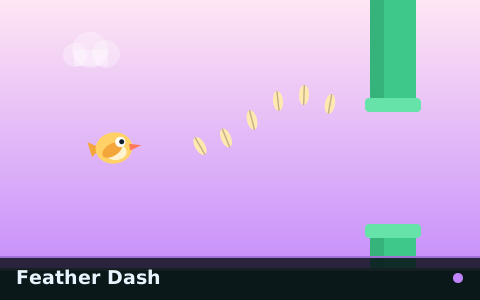
Feathers appear on lines that are slightly worse than the safe one. Hit the quota and the next quota is larger.

Four stages, each with its own objective, layered on top of each other. The hardest game here, and the most specific about why you failed.
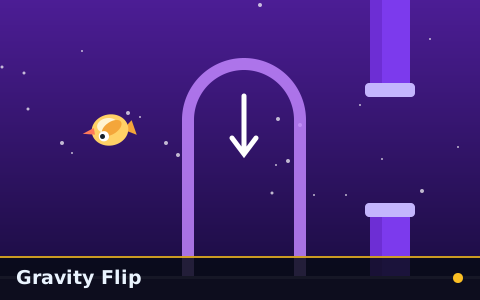
Fly through a flip gate and down becomes up. Your controls do not change — everything else does.

A thruster you hold instead of a flap you tap. Altitude becomes continuous, and fuel makes it finite.
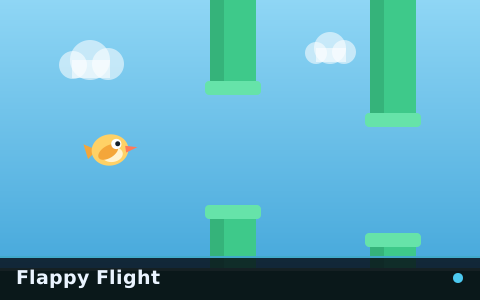
The reference flappy game: one flyer, one gap type, a speed that keeps climbing and nothing else in the way.
Cornerstone Guide
What arcade gravity actually is, why it is not the real thing, how terminal velocity and buoyancy change a game's feel, and what happens when you alter gravity mid-run.
Mechanics
What changing gravity does to a flying game in practice: decision time, rhythm, the danger surface, and why low gravity is usually more dangerous than high.
Cornerstone Guide
Why difficulty should approach a ceiling rather than rise forever, how the four levers interact, and why the time between decisions falls faster than any individual curve.
Browse the flappy challenge games, the full library of 30 games, or the newest additions. If you are not sure what to try next, the best flappy games to play online suggests an order.