Challenge
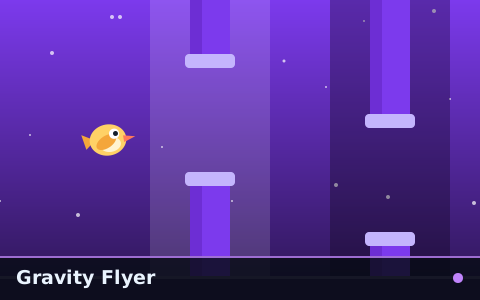
Gravity Flyer
Coloured zones change how heavy you are. Same button, same gates, three completely different flight models.
Balloon Escape inverts the genre's one rule. The balloon has buoyancy, so it rises constantly without any input from you, and pressing the button vents gas to push it down. Everything you learned elsewhere on this site is now exactly backwards.
Guide a rising balloon down through hazards. Your input vents the balloon downward; releasing it lets buoyancy carry you back up.
| Action | Keyboard / mouse | Touch |
|---|---|---|
| Vent (descend) | Space, W or Arrow Up | Tap anywhere on the play area |
| Practice mode | Choose it on the ready screen | Choose it on the ready screen |
| Pause / resume | P or Esc | Pause button in the game bar |
| Restart | R | Restart button in the game bar |
Pause with P or Esc, restart with R. The game pauses automatically if you switch tabs. More detail in keyboard controls for browser games and touch controls for arcade games.
This is the most interesting five minutes on the site for anyone who has already got good at flappy games, because being good at them actively hurts. The association between pressing and rising is deep enough that experienced players fly into the ceiling repeatedly while narrating aloud that they should not be. Players who have never played a flappy game before often do better in their first two minutes.
Mechanically the flight model is the balloon preset: no gravity at all, a constant upward buoyancy of 620, and a vent impulse of +380 that pushes down. Terminal speeds are symmetrical, and the rotation tilts the balloon toward its direction of travel so your state is always readable at a glance.
Because the default direction of travel is up, the hazard layout is inverted too. The dangerous surface is the ceiling, the safe direction is down, and the obstacles hang more heavily from above. Wandering off the bottom of the screen is not possible: a soft floor stops you rather than killing you, so an over-vent is recoverable in a way an over-flap elsewhere is not.
There is a practice mode on the ready screen. It removes scoring and the fail state entirely — you simply fly, and hitting something resets you to a clear position rather than ending the run. A practice session lasts ninety seconds, after which you can switch straight back to a scored run. It exists because the fastest way to unlearn an ingrained control association is to use the new one without anything riding on it, and three minutes of practice here is worth twenty scored attempts.
Balloon Escape uses the site's shared flight model: gravity acts continuously on your vertical velocity, a flap sets that velocity rather than adding to it, and hard caps on rise and fall speed mean no situation is ever unrecoverable. The mechanics this game leans on are Flapping, Buoyancy, Timing and obstacle avoidance.
If you want the numbers behind that, how flappy-style games work sets out the whole model, and how flapping mechanics work explains why a flap that sets velocity behaves so differently from one that adds to it.
Chosen by shared category, mechanics and difficulty — not at random.
Coloured zones change how heavy you are. Same button, same gates, three completely different flight models.
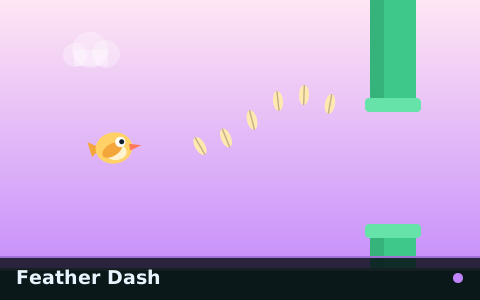
Feathers appear on lines that are slightly worse than the safe one. Hit the quota and the next quota is larger.

Four stages, each with its own objective, layered on top of each other. The hardest game here, and the most specific about why you failed.

A thruster you hold instead of a flap you tap. Altitude becomes continuous, and fuel makes it finite.
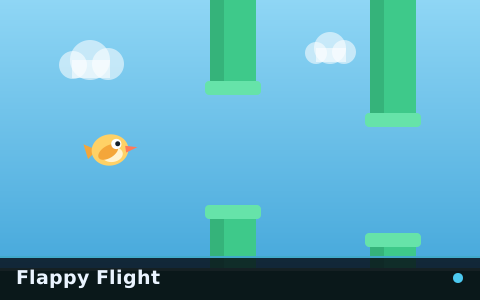
The reference flappy game: one flyer, one gap type, a speed that keeps climbing and nothing else in the way.

Weak gravity, heavy drag and a long, slow response to every stroke. The same game at a completely different tempo.
Controls
What happens between a key press and a flap: edge detection, cooldowns, input unification across devices, and why one press must always mean exactly one flap.
Practice
The difference between playing a lot and practising, how to structure a session, and why the run that feels wasted is usually the one that taught you something.
Cornerstone Guide
What actually happens when you flap: impulse versus accumulation, cooldowns, rotation lag, the feel of different flap forces, and why the wing animation matters.
Browse the flappy challenge games, the full library of 30 games, or the newest additions. If you are not sure what to try next, the best flappy games to play online suggests an order.