On this page
Four kinds of flying game
"Flying game" covers a range so wide that the phrase is close to meaningless. It is worth separating out four distinct things, because they share a subject and almost nothing else.
| Type | Control model | Session | Core skill |
|---|---|---|---|
| Flight simulator | Continuous, many axes | 20 min – hours | Procedure and instrument reading |
| Arcade flight / shooter | Continuous, 2 axes plus weapons | 5 – 30 min | Positioning and target priority |
| Glider / physics flyer | Continuous, 1 – 2 axes | 2 – 15 min | Momentum management |
| Flappy / one-input | Discrete, 1 input | 20 s – 6 min | Timing and lead |
The row that matters is the control model. Everything else — session length, art style, subject — follows from whether the player's input is continuous or discrete, and how many degrees of freedom they have.
Continuous versus discrete input
A simulator or an arcade flight game gives you a continuous input: a stick position, a throttle setting, a held key. Your craft's state is a direct function of what you are currently doing, and adjusting is a matter of degree.
A flappy game gives you a discrete one. You cannot hold your altitude; you can only repeatedly interrupt your fall. Between inputs, you are not flying — you are falling, temporarily.
That difference produces the genre's characteristic tension. In a continuous-input flying game, doing nothing maintains your state. In a discrete-input one, doing nothing has a deadline. There is no hover, no trim and no neutral, and the absence of a neutral is exactly what makes a five-second decision feel urgent.
Realism is not the axis
It is tempting to describe the difference as realism, with simulators at one end and flappy games at the other. That is misleading, because a flappy game is not an inaccurate simulation — it is not a simulation at all.
There is no lift in a flappy game. No angle of attack, no airspeed, no stall, no air density, no wing area. A flap is not a wingbeat producing thrust; it is an instruction that sets your vertical velocity to a fixed number. The bird is a metaphor for a control scheme, not a model of a bird.
Nothing on this site models real aerodynamics, and we say so on every page where it could matter. If you want to understand how real flight works, an arcade game is the wrong teacher — our fact-checking policy sets out how we handle the distinction between game mechanics and real-world physics.
The useful axis is not realism but degrees of freedom. A simulator gives you many and asks you to coordinate them. A flappy game gives you one and asks you to time it perfectly. Both can be deep; they are deep in completely different directions.
What each format is good at
What flappy games do better
- Instant comprehension. No tutorial, no control screen, no settings. A four-second explanation covers everything.
- Short sessions. A run is 20 seconds to 6 minutes. You can play one on a bus without committing to anything.
- Fast failure loops. Failure returns you to a playable state in about a second, which makes the attempt–adjust–retry cycle the whole experience.
- Device independence. One input works identically with a keyboard, a mouse and a thumb, which is why the format took over on phones.
- Measurable improvement. One variable means improvement is visible quickly and attributable to something specific.
What traditional flying games do better
- Spatial depth. Two or three axes of movement allow genuine tactical positioning that a single axis cannot.
- Long-form progression. Campaigns, upgrades and narrative need sessions long enough to contain them.
- Variety within a session. A thirty-minute flight game can change what it is asking several times. A flappy run cannot, which is why the good ones change between runs instead.
- Expression. More degrees of freedom allow more than one way to be good, and therefore recognisable individual styles.
Where the two overlap
The genres are not sealed off from each other, and the most interesting flappy games borrow from the other side deliberately.
Rocket Flap takes the continuous input model and keeps everything else, which turns the game into an altitude-steering exercise with a fuel budget — much closer to a glider game than to a flappy one.
Underwater Flap borrows momentum management: heavy drag and weak gravity make it behave like a physics flyer, where planning two obstacles ahead is mandatory because corrections take so long to express.
Wind Rider borrows the environmental variable that arcade flight games use constantly and that flappy games almost never do. A shifting wind field changes the flap rhythm that holds your height, which makes the baseline itself a moving target.
What none of them do is add a second input, because that would change genre rather than extend it.
Which one should you play?
The honest answer is that they satisfy different appetites and the question is mostly about how much time you have and how much attention you want to spend.
- Five minutes and a phone — a flappy game, every time. Nothing else in gaming fits that slot as well.
- An hour and a desk — an arcade flight game or a glider will give you more variety across that hour.
- You want to improve at something measurable — a flappy game, because with one variable, improvement is unambiguous.
- You want to feel like a pilot — not a flappy game. It is a rhythm game with a bird on it, and it does not pretend otherwise.
Key takeaways
- The defining difference is discrete versus continuous input, not realism or subject matter.
- Flappy games have no neutral state — doing nothing has a deadline, which is where the tension comes from.
- A flap is not a modelled wingbeat; it sets vertical velocity to a fixed number. Nothing here simulates aerodynamics.
- One-input games win on comprehension, session length, failure loops and device independence.
- Traditional flying games win on spatial depth, long-form progression and room for individual style.
Frequently asked questions
Do flappy games simulate real flight?
Is a flappy game a rhythm game?
Can playing flappy games help with other flying games?
Why do so many flying games use one input?

Alex Morgan
Browser Games Editor & Interactive Gaming Content Specialist
Alex Morgan is the editorial byline for everything published on Flappy Arcade — the design notes, the flight-model tuning and the strategy guides for all 30 games. More about our editorial byline.
Published · Last updated
Games mentioned in this guide
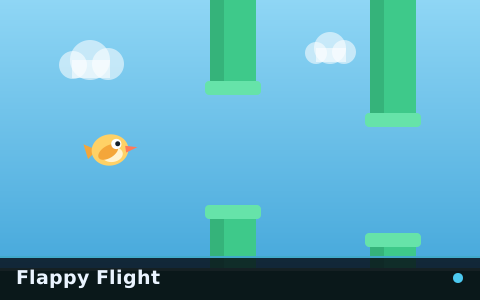
Flappy Flight
The reference flappy game: one flyer, one gap type, a speed that keeps climbing and nothing else in the way.

Rocket Flap
A thruster you hold instead of a flap you tap. Altitude becomes continuous, and fuel makes it finite.

Underwater Flap
Weak gravity, heavy drag and a long, slow response to every stroke. The same game at a completely different tempo.
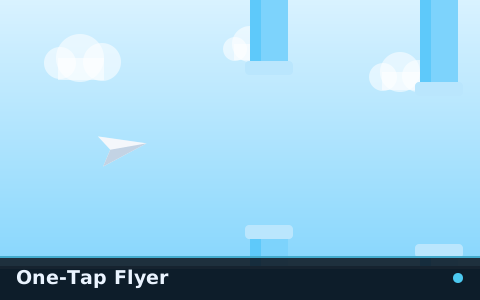
One-Tap Flyer
The gentlest game on the site. A floaty paper plane, wide spacing and enough time to see every decision coming.