On this page
One input, continuous outcomes
The standard objection to one-tap games is that a single binary input cannot produce interesting play. It is a reasonable-sounding objection and it is wrong, for a reason worth stating precisely.
The input is binary. The outcome is not, because the input does not set your position — it sets your velocity, and position is the accumulation of velocity over time. Where a tap puts you therefore depends entirely on the state you were in when you made it, and the state is continuous.
The practical consequence is that one button gives you a continuous range of results selected by timing. A tap made while falling fast is a rescue; the same tap made while already rising is almost nothing. A player is not choosing between two options — they are choosing a moment from a continuum.
A binary input applied to a continuous state produces a continuous outcome. That is the whole reason one button is enough.
The second half: not pressing is a decision
The other source of depth is what happens when you do nothing.
In most games, the null input is neutral. You stand still, you hold position, nothing changes. In a one-tap flying game, gravity is acting continuously, so choosing not to press for another quarter of a second is a genuine tactical choice with a precise and predictable consequence.
This inverts what "playing well" looks like. Skilled play in a flappy game is mostly visible as restraint — the flaps you did not make. Watch a strong player and a weak one side by side and the most obvious difference is not reaction speed or accuracy; it is that the strong player presses considerably less often.
What a designer gains
- No control barrier. No tutorial, no key rebinding, no gamepad support, no settings screen. The game is comprehensible in four seconds.
- Device independence. A space bar, a mouse click and a thumb produce identical input. The same build works on a laptop, a phone and a tablet with no adaptation at all.
- Accessibility gains. One input means the game is playable with a single switch, a single key, or any assistive device that can produce one activation.
- Clean attribution of failure. With one variable, a player always knows what went wrong. There is no "I pressed the wrong button" — only "I pressed at the wrong time", which is improvable.
- Tiny scope. No input handling complexity means the design effort goes into tuning, which is where it belongs in an arcade game.
What a designer gives up
It is a real trade rather than a free win, and pretending otherwise leads to bad one-tap games.
- Spatial tactics. One axis of movement means no flanking, no positioning, no route choice. Everything happens on a line.
- Variety within a run. A thirty-minute game can change what it is asking several times. A ninety-second run cannot, which is why good one-tap games change between runs instead of within them.
- Expression. With one variable there are fewer ways to be good, so individual style is limited to rhythm and risk appetite.
- Recoverability. With no second input, there is no emergency option. Every mistake has to be recoverable using the same tool that caused it.
That last one is the reason one-tap games live or die on their speed caps. If a fall can exceed what a flap undoes, the player reaches a state where the game has stopped listening — and with only one input, there is nothing else to try.
Variations that stay within one input
There is more room inside the constraint than it first appears, and the interesting one-tap games explore it rather than adding a second button.
| Variation | How it changes things | Game |
|---|---|---|
| Impulse (standard) | Tap sets upward velocity | Flappy Flight |
| Held thrust | Altitude becomes a steered quantity | Rocket Flap |
| Inverted impulse | Buoyancy lifts; the tap pushes down | Balloon Escape |
| Context-dependent | The same tap does the opposite after a flip gate | Gravity Flip |
All four use exactly one input. What changes is the mapping between the input and the world, and each mapping produces a game that feels genuinely different to play. Balloon Escape is the most instructive: nothing about it is mechanically complex, and experienced flappy players find it the hardest control on the site because the press-means-up association is learned so deeply.
Why one-tap games suit browsers specifically
The format and the platform fit together almost too neatly.
A browser game has to work on an unknown device with an unknown input method, launched from a link, with no installation and no settings persistence beyond what you choose to store locally. A one-input game solves all of those at once: there is nothing to configure, nothing to detect and nothing to explain.
It also solves the hardest problem in browser gaming, which is that the player has not committed to anything. Somebody who clicked a link will leave the moment they are confused. A game they can understand before the page has finished settling is a game they will actually try — and that is worth more than any amount of mechanical depth they would never have reached.
The technical side of this — canvas, the animation loop, load times, how the games behave across browsers — is covered in HTML5 flying games explained.
Key takeaways
- A binary input applied to a continuous state produces continuous outcomes — that is why one button is enough.
- Doing nothing is a real decision, because gravity never stops; skilled play looks like restraint.
- One input buys comprehension, device independence and accessibility; it costs spatial tactics and in-run variety.
- With no second input, speed caps are essential — a fall that a flap cannot undo leaves the player with nothing to try.
- The mapping between input and world can change (held, inverted, context-dependent) without adding a button.
Frequently asked questions
Is one input too simple to be interesting?
Can one-tap games be played with assistive devices?
Why do so many browser games use one input?
What is the hardest one-tap control on this site?

Alex Morgan
Browser Games Editor & Interactive Gaming Content Specialist
Alex Morgan is the editorial byline for everything published on Flappy Arcade — the design notes, the flight-model tuning and the strategy guides for all 30 games. More about our editorial byline.
Published · Last updated
Games mentioned in this guide
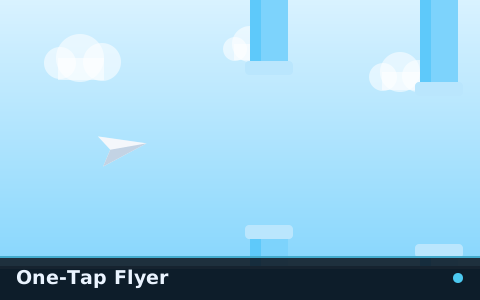
One-Tap Flyer
The gentlest game on the site. A floaty paper plane, wide spacing and enough time to see every decision coming.
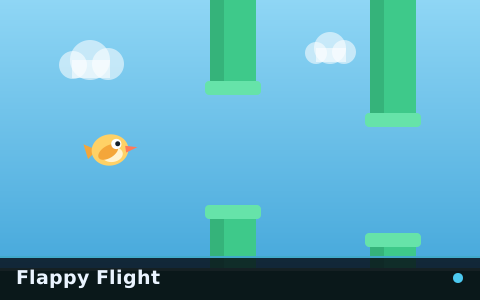
Flappy Flight
The reference flappy game: one flyer, one gap type, a speed that keeps climbing and nothing else in the way.

Balloon Escape
The balloon rises on its own. Your button vents it downward — every instinct you have is now wrong.

Rocket Flap
A thruster you hold instead of a flap you tap. Altitude becomes continuous, and fuel makes it finite.