
Adventure
Jungle Flyer
Vines hang from the canopy at irregular lengths and spires rise from the floor. Familiar physics, unfamiliar shapes.
Underwater Flap keeps the obstacles and changes the water around them. Gravity is weak, drag is strong, buoyancy nudges you gently upward, and a stroke takes far longer to do its work. It looks like the rest of the site and controls nothing like it.
Swim through coral gates with a flight model where everything takes longer. Standard scoring, slow tempo, and a strong emphasis on planning ahead.
| Action | Keyboard / mouse | Touch |
|---|---|---|
| Stroke | Space, W or Arrow Up | Tap anywhere on the play area |
| Pause / resume | P or Esc | Pause button in the game bar |
| Restart | R | Restart button in the game bar |
Pause with P or Esc, restart with R. The game pauses automatically if you switch tabs. More detail in keyboard controls for browser games and touch controls for arcade games.
The flight model is the swim preset: gravity 520 against the standard 1,500, a mild buoyancy of 120 pushing up, a stroke impulse of −280, terminal speeds of only 300 in either direction, and a drag coefficient of 0.55 that bleeds velocity away quickly. Every number is smaller, which means everything takes longer and nothing runs away from you.
The result is the most forgiving physics on the site and, counter-intuitively, a game that punishes short-term thinking harder than most. Because a stroke takes so long to take effect, reacting to the obstacle in front of you does not work — by the time the stroke lands you are already at it. You have to be making the move for the obstacle after next.
Strong drag also means the flyer settles rather than accumulating. A panicked burst of strokes underwater produces a slow rise that then stops, where the same burst in air would launch you into the ceiling. That makes it an unusually good game for nervous players, and a genuinely relaxing one once the tempo clicks.
Coral columns and kelp fronds form the obstacle field, currents drift across some sections, and rising bubble streams mark where a current is strongest. Nothing here is fast. The game is the site's argument that a flappy game does not have to be tense to be difficult.
Underwater Flap uses the site's shared flight model: gravity acts continuously on your vertical velocity, a flap sets that velocity rather than adding to it, and hard caps on rise and fall speed mean no situation is ever unrecoverable. The mechanics this game leans on are Flapping, Buoyancy, Drag and obstacle avoidance.
If you want the numbers behind that, how flappy-style games work sets out the whole model, and how flapping mechanics work explains why a flap that sets velocity behaves so differently from one that adds to it.
Chosen by shared category, mechanics and difficulty — not at random.
Vines hang from the canopy at irregular lengths and spires rise from the floor. Familiar physics, unfamiliar shapes.
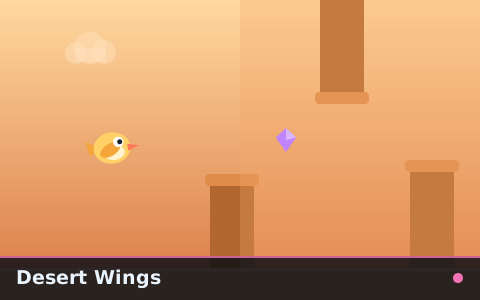
Sandstorm gusts push you sideways as well as up. Gems are buried in the worst of it.
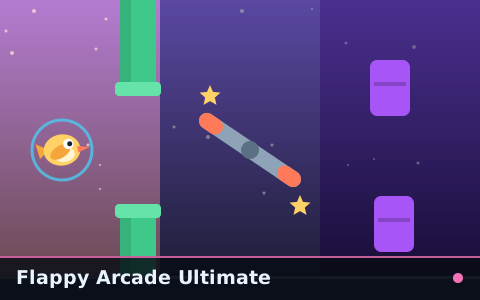
Three skies, three obstacle sets, power-ups, collectibles, a difficulty selector and a boss gate at the end of it.
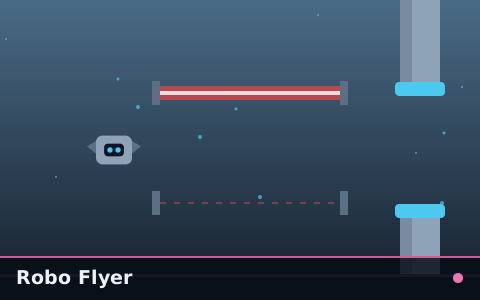
Energy beams that switch on and off on fixed cycles. The safe route is a moment rather than a place.

The balloon rises on its own. Your button vents it downward — every instinct you have is now wrong.
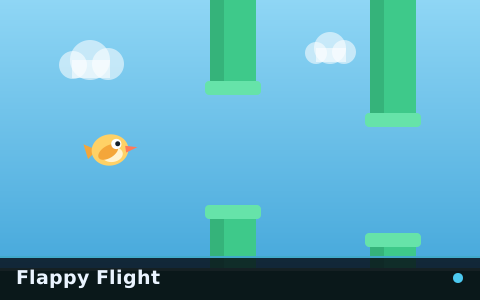
The reference flappy game: one flyer, one gap type, a speed that keeps climbing and nothing else in the way.
Cornerstone Guide
What arcade gravity actually is, why it is not the real thing, how terminal velocity and buoyancy change a game's feel, and what happens when you alter gravity mid-run.
Mechanics
What changing gravity does to a flying game in practice: decision time, rhythm, the danger surface, and why low gravity is usually more dangerous than high.
Cornerstone Guide
How one-input flappy games differ from flight sims, shooters and glider games — in control model, skill demands, session length and what they can and cannot teach you.
Browse the flappy adventure games, the full library of 30 games, or the newest additions. If you are not sure what to try next, the best flappy games to play online suggests an order.