Adventure
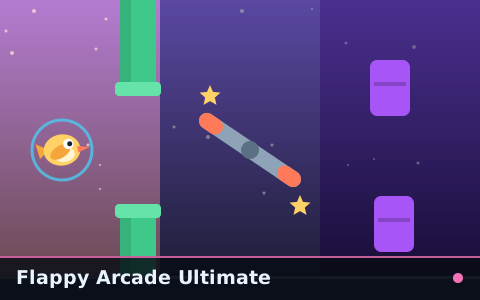
Flappy Arcade Ultimate
Three skies, three obstacle sets, power-ups, collectibles, a difficulty selector and a boss gate at the end of it.
Jungle Flyer changes what is in the way rather than how you fly. Instead of paired gates there are single obstacles — vines hanging from the canopy and spires rising from the floor — alternating in a rhythm that makes the whole field feel like a slalom.
Weave through alternating hanging vines and rising spires. Each obstacle cleared scores, fruit clusters add bonus points, and the canopy thickens as you progress.
| Action | Keyboard / mouse | Touch |
|---|---|---|
| Flap | Space, W or Arrow Up | Tap anywhere on the play area |
| Pause / resume | P or Esc | Pause button in the game bar |
| Restart | R | Restart button in the game bar |
Pause with P or Esc, restart with R. The game pauses automatically if you switch tabs. More detail in keyboard controls for browser games and touch controls for arcade games.
One-sided obstacles are a subtly different problem from gates. A gate constrains you from both directions and therefore tells you exactly where to be. A hanging vine only tells you where not to be, which leaves a large safe area and a choice about how much of it to use.
The temptation is to use as much of it as possible — to dive to the floor under every vine. That works for two or three obstacles and then fails, because the spires alternate with the vines, and a flyer that has just dropped to the floor is in exactly the wrong place for the spire that follows. The field is a slalom, and the correct line stays near the middle and makes small moves.
Obstacle lengths vary irregularly, from short hanging fronds to vines that reach most of the way down, and the length is always fully visible before you reach it. Clearance — the gap between the obstacle's end and the opposite surface — never drops below a fixed floor, so there is always a flyable line however dense the canopy looks.
Fruit collectibles hang in small clusters near the obstacles and are worth taking when they are on your line. The environment progresses through three canopy densities across a run, announced by a visible change in the background layers, which is the game's pacing mechanism rather than a difficulty spike.
Jungle Flyer uses the site's shared flight model: gravity acts continuously on your vertical velocity, a flap sets that velocity rather than adding to it, and hard caps on rise and fall speed mean no situation is ever unrecoverable. The mechanics this game leans on are Flapping, Gravity, Obstacle Avoidance and collectibles.
If you want the numbers behind that, how flappy-style games work sets out the whole model, and how flapping mechanics work explains why a flap that sets velocity behaves so differently from one that adds to it.
Chosen by shared category, mechanics and difficulty — not at random.
Three skies, three obstacle sets, power-ups, collectibles, a difficulty selector and a boss gate at the end of it.
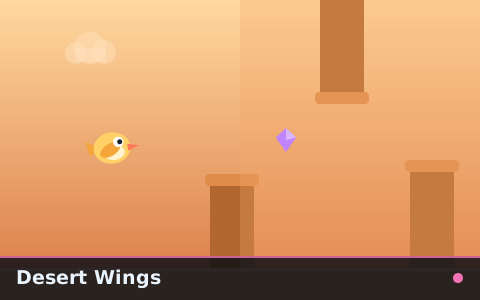
Sandstorm gusts push you sideways as well as up. Gems are buried in the worst of it.
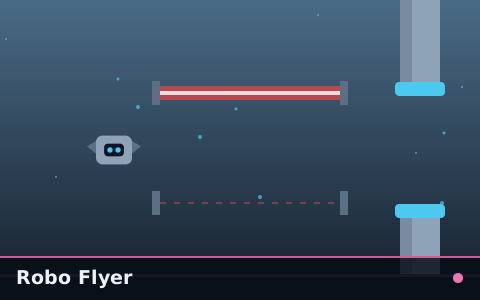
Energy beams that switch on and off on fixed cycles. The safe route is a moment rather than a place.

Weak gravity, heavy drag and a long, slow response to every stroke. The same game at a completely different tempo.
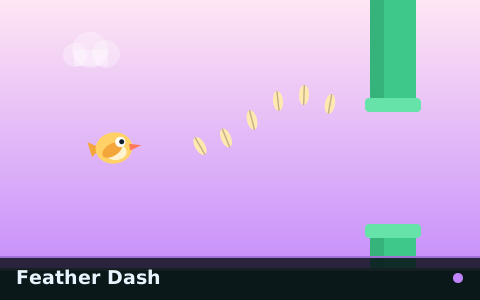
Feathers appear on lines that are slightly worse than the safe one. Hit the quota and the next quota is larger.
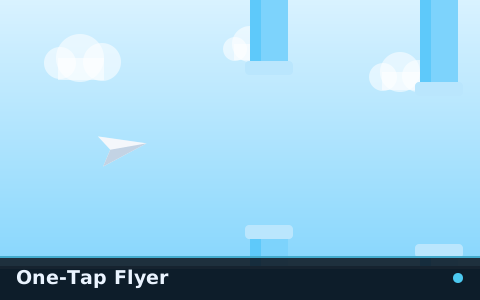
The gentlest game on the site. A floaty paper plane, wide spacing and enough time to see every decision coming.
Cornerstone Guide
What avoidance actually asks of a player, the four obstacle families and the different skills they test, and why reading two obstacles ahead changes everything.
Design
The difference between a hard obstacle and an unfair one, the five rules that prevent unfairness, and how to tell which side of the line a game is on.
Design
A short checklist for telling a good flying arcade game from a bad one, from the first ten seconds to the failure message, with what each item actually indicates.
Browse the flappy adventure games, the full library of 30 games, or the newest additions. If you are not sure what to try next, the best flappy games to play online suggests an order.